Lenco Dent Puller: How the LP-200 and LP-2000 Systems Work
Discover how the Lenco Dent Puller simplifies auto body repairs, removes dents efficiently, and helps restore damaged vehicle panels.

Introduction to Lenco Dent Pullers
Lenco dent pullers are professional electric dent pulling systems built for collision repair. They use electrical resistance to weld pull points directly onto damaged steel body panels, allowing technicians to draw out dents from the exterior without ever needing to reach the backside of the panel. If you've spent time fighting with hammer-and-dolly access on a quarter panel or door skin, you already understand why that matters.
This guide focuses on two specific models: the Lenco Pull LP-200 (120V) and the LP-2000 (230V, part number LC20720 / 20720). Both systems rely on the same core principle: weld a stud or star tip to the dent, pull it out with a slide hammer, then finish the surface, but they differ in voltage requirements, pull interface design, and ideal shop environment.
These units are aimed at body shop professionals, mobile dent repair technicians, and serious DIYers who want faster, cleaner metal straightening than traditional methods can deliver.
They are not budget tools. The LP-200 has historically been listed around $1,395.00 in the U.S., and the LP-2000 falls in a similar professional price range. Think of them as an investment in repair quality and cycle time.
In the sections below, we'll break down exactly how these systems work on steel panels, compare their specifications and power requirements side by side, and cover practical tips on choosing the right model for your situation, along with the safety fundamentals you need to use a Lenco dent puller correctly.

How Lenco Dent Pullers Work on Steel Panels
The core process is straightforward: you weld a pull point onto the damaged area, use a slide hammer or integrated puller to draw the metal back to its original contour, then clean up the weld marks and finish the panel. What makes Lenco systems effective is how precisely they control that weld-and-pull sequence, minimizing heat damage and panel distortion compared to cruder methods.
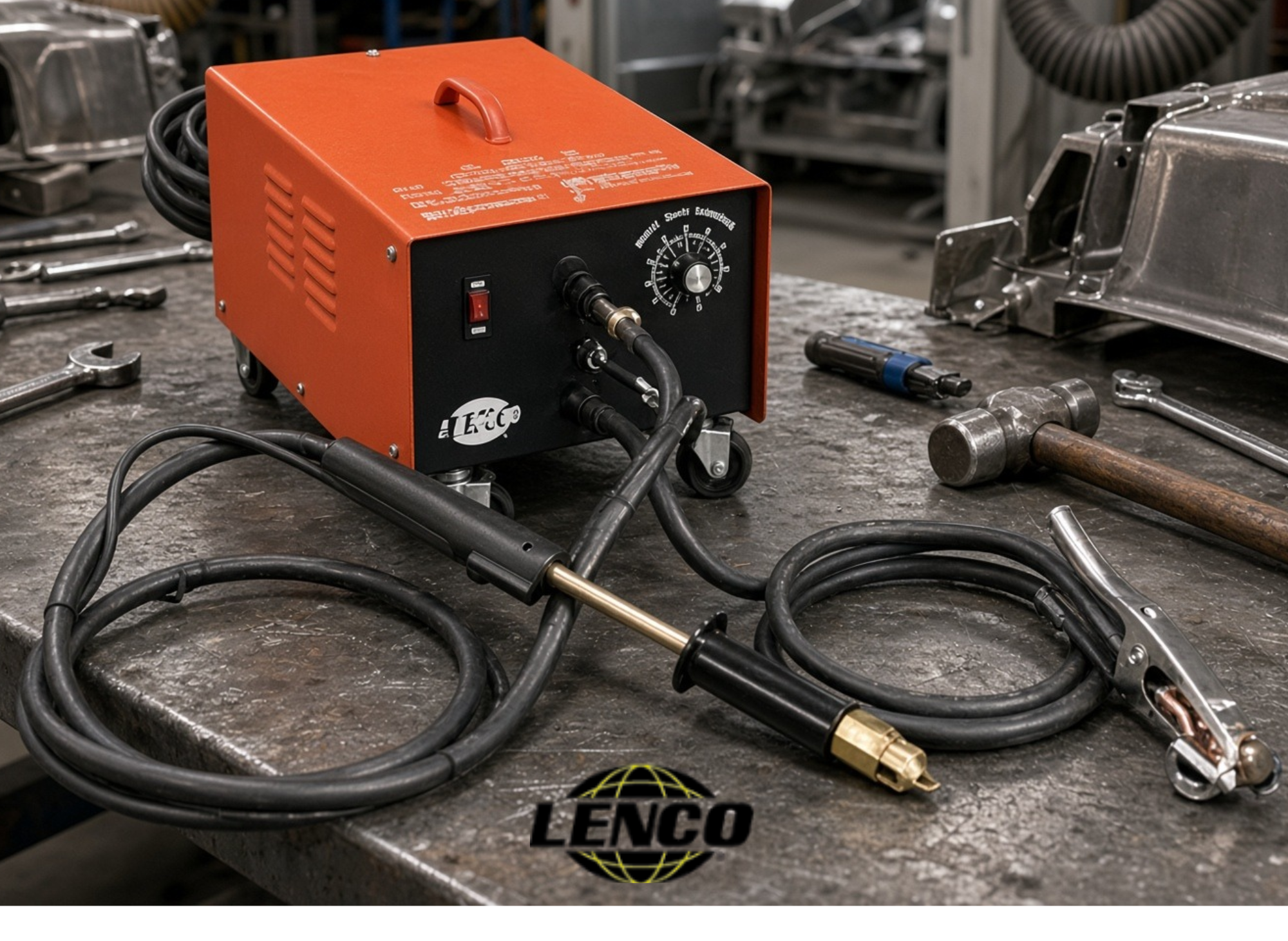
LENCO MARINE 120 Volt Portable Dent Puller
Portable Dent Puller 120 Volt Primary voltage: 120 volts single phase 60/50 Hz Line Fuse: 30 Amp Size: 11-1/2"H X 15"W x 16-3/4"L Power Input Cable: 25`, No. 12/3 wire Cable Assembly Length: 7' ground, 7' power Maximum Welding Capacity: 20 gauge Autobody steel Weight: 64 lbs. (29 kg)
LP-200: Stud Welding Step by Step
The LP-200 welds small studs onto dented panels using controlled electric current. Here is the typical workflow:
- Prepare the surface. The technician prepares the panel by cleaning it to achieve electrical contact. This means stripping paint, primer, and any coatings from the dent area down to bare steel. Without clean metal, the weld will fail or produce a weak bond.
- Position the ground clamp. Attach the ground clamp to bare metal close to the repair zone. A solid ground connection is critical; a loose or distant clamp introduces resistance that weakens the weld.
- Weld the studs. Using the LP-200's gun, weld draw pins or studs onto the low spots of the dent. The unit uses electrical resistance to fuse each stud to the panel surface in a fraction of a second.
- Pull with the slide hammer. Attach a slide hammer to one or more studs and pull gradually. The slide hammer converts each impact into a controlled pulling force that draws the metal outward. Use multiple lighter pulls rather than one aggressive stroke — over-pulling stretches the metal and creates new problems.
- Remove and finish. Cut or twist off the studs, grind the weld spots flush, and check the surface with a body file or long sanding block. Apply a thin skim coat of body filler only where needed. Repairing panels with Lenco dent pullers requires paint removal and refinishing, but the goal is minimal filler — not burying damage under a thick layer.
Lenco systems eliminate the need for drilling holes in body panels, which is a significant advantage over older pull-rod methods that required plug welding access holes after the repair.

Lenco LencoPull 230 V Portable Dent-Pulling Systems LC20720
Dent Puller, LencoPull 230 V Portable, Kit
LP-2000: Star Tip and Built-In Slide Hammer
The LP-2000 (LC20720) takes a different approach. Instead of welding separate studs, it uses a star tip that spot-welds directly to the outer surface of the dented steel panel.
Here's where the workflow speeds up:
- The star tip is loaded into the electrode head and pressed against the cleaned panel surface.
- The operator triggers the weld, fusing the star tip to the metal.
- The built-in slide hammer, integrated directly into the welding gun, lets the technician pull immediately without switching to a separate tool.
- After pulling, the star tip is twisted or rotated until it breaks off cleanly, leaving minimal surface disruption.
This integrated design is faster for repeated pulls along a crease or across a large damage area. You weld, pull, twist off, reposition, and repeat, all with the same tool in your hand.
The LP-2000 can also shrink light-gauge metals effectively using a blunt shrink tip (the A-201 accessory). With the timer control set to maximum, the tip applies concentrated heat to stretched areas, allowing the metal to contract back toward its original contour. This is particularly useful on crowned surfaces like quarter panel edges or roof lines.
What Panels Can You Work On?
Lenco dent pullers are effective on light-gauge steel car panels — the mild steel and common OEM body-gauge steel found on most passenger vehicles. They handle panels up to approximately 20 gauge, which covers the majority of automotive exterior skins.
What they cannot do:
- Lenco dent pullers are not suitable for use on aluminum or plastic panels. The welding process depends on steel's specific resistance characteristics, and aluminum conducts heat differently, risking warpage or failed welds.
- Galvanized steel and high-strength steel alloys may also behave unpredictably. If you're working on newer vehicles with exotic panel materials, verify compatibility with Lenco before proceeding.
Exterior-Only Access
One of the strongest advantages of the Lenco method is that the LP-200 can repair dents without accessing the panel backside. Everything happens from the exterior surface.
This matters most on panels where backside access is blocked by structural members, sound deadening, interior trim, or adhesive-bonded components:
- Quarter panels
- Door skins (especially with side-impact beams)
- Roof rails and sail panels
- Trunk lids with internal bracing
You avoid tearing apart interiors, removing headliners, or pulling trim clips — all of which add labor hours and create opportunities to break fasteners or damage trim pieces.
How This Compares to Other Methods
Traditional hammer-and-dolly work requires backside access by definition. Glue pull systems avoid welding but offer less precise control on deeper dents and can fail on textured or curved surfaces. Generic stud guns without integrated slide hammers require more tool swapping.
Lenco's controlled weld-and-pull process, when used correctly, tends to reduce panel stretching and keeps filler thickness to a minimum. The key phrase is "when used correctly" — technique still matters.

Lenco LP-200 vs. LP-2000 (LC20720): Specifications, Power, and Buying Tips
Both the LP-200 and LP-2000 are portable dent pulling systems that share the same housing dimensions and similar weight. The core differences come down to input voltage, the pull interface, and which shop environments each model fits best.
LP-200 (120V) Overview
The LP-200 is an electric dent puller designed for 120-volt, 50/60 Hz power — the standard outlet found in most North American shops and garages. The LP-200 operates on 120V 60/50 Hz power, which means it can plug into a correctly rated wall outlet without requiring special wiring.
Key details:
Specification | LP-200 (120V) |
Input Voltage | 120V AC, 50/60 Hz |
Line Fuse | 20 Amp |
Housing Dimensions | ~11-1/2" H × 15" W × 16-3/5" L |
Weight | ~64 lbs (29 kg) |
Power Input Cable | 25 ft, 12/3 wire |
Welding / Ground Leads | ~7 ft each |
Pull Method | Stud welding + separate slide hammer |
The LP-200 uses stud welding plus a separate slide hammer or pulling attachment. This gives you flexibility — you can swap in different pulling bars, multi-hook tools, or T-handle pullers depending on the shape and depth of the dent. The compact, box-style housing stores easily on a service cart or workbench.
Cable Length and Mobility
The 25-foot main power cable is long enough to let you work comfortably around an entire vehicle without dragging the base unit from bay to bay. The 7-foot welding and ground leads add additional reach from wherever you stage the unit.
In a crowded body shop, this cable configuration means you can set the LP-200 on a cart near one fender and still reach the opposite quarter panel in many cases. Long leads reduce downtime spent repositioning equipment.
Power Requirements for the LP-200
The LP-200 plugs into a standard 120V outlet, but there's an important caveat: the circuit needs to genuinely support 20 amps without sharing the load with other high-draw tools. If you're running a grinder or plasma cutter on the same circuit, expect nuisance breaker trips.
Before purchasing, check your shop's electrical panel for a dedicated 20A circuit. Avoid using long extension cords; voltage drop across thin or lengthy cords will reduce welding performance and can cause weak stud welds.
LP-2000 (230V, LC20720) Overview
The Lenco LP-2000 operates on 230V AC power (single-phase, 50/60 Hz), making it the right choice for shops with 230V service and for international markets where higher voltage is standard.
Specification | LP-2000 (230V) |
Input Voltage | 208/230V AC, 50/60 Hz |
Line Fuse | 20 Amp |
Housing Dimensions | ~11-1/2" H × 15" W × 16-3/4" L |
Weight | ~64 lbs (29 kg) |
Power Input Cable | 25 ft, 12/3 wire |
Welding / Ground Leads | ~7 ft each |
Pull Method | Star tip + built-in slide hammer |
The standout feature: it features a built-in slide hammer for dent pulling, integrated directly into the welding gun. The power input cable length is 25 feet, matching the LP-200's reach. Combined with the 7-foot leads, you get the same excellent mobility around the vehicle.
The 230V supply allows the transformer to deliver more consistent current during repeated pulls, which matters when you're working a long crease or a panel with multiple damage points in sequence.

When to Choose LP-200 vs. LP-2000
The decision usually comes down to three factors:
- Available power. If your shop only has 120V circuits in the bays, the LP-200 is your option unless you're willing to run new wiring. Shops with 230V service have the flexibility to choose either, but the LP-2000 leverages that higher voltage for smoother performance.
- Volume and workflow. For high-throughput collision shops doing repeated metal work all day, the LP-2000's integrated star tip and built-in slide hammer reduce tool swapping and speed up each pull cycle. For lower-volume or mobile operations, the LP-200's flexibility with interchangeable pulling attachments may be the better fit.
- Panel types. Both units handle the same gauge range of steel panels. Neither is rated for aluminum. If your shop primarily services vehicles with steel body panels, either will do the job.
Price and Value
The LP-200 has been listed around $1,395 from U.S. retailers. The LP-2000 (230V) price ranges roughly from $990 to $1,400 depending on the dealer, condition, and current availability.
These are professional-grade systems. The price reflects the engineering, cable quality, and integrated design, not a markup on commodity parts. A Lenco dent puller is meant to pay for itself through faster repair times, reduced filler use, and higher-quality metal finishing that holds up over the long term.
Always verify current pricing with authorized distributors or retailers, as costs shift with supply chain conditions and regional availability.
Accessories and Consumables to Budget For
Don't overlook the ongoing cost of consumables when planning your purchase:
- Star tips (QP-451, pack of 10) - wear items that need regular replacement
- Shrink tips (A-201) - for heat-shrinking stretched metal
- Welding studs (SPK-109) and stud tips (SPK-102) - for deeper or structural pulls
- Molding rivet tips (SPK-103) and rivets (SPK-110) - for trim and molding reattachment
- Grinding discs - for cleaning weld marks after each pull
- Service cart (A-2000) - optional, but highly recommended for mobility
Budget for these from day one. Running out of star tips mid-repair is not a problem you want to solve on a Friday afternoon.
Safety and Usage Fundamentals
Every pull session should start with these basics:
- Wear welding gloves, safety glasses or a face shield, and hearing protection. The welding arc produces sparks, UV light, and noise.
- Strip paint and coatings from the weld area before every pull. Clean metal equals strong welds. Contaminated surfaces cause tip failures.
- Position the ground clamp on clean bare metal, as close to the repair area as practical.
- Follow Lenco's official manual for duty cycle guidance and grounding procedures. Public documentation doesn't specify exact duty cycle percentages, so rely on the manufacturer's recommendations to avoid overheating the transformer.
- Keep a fire extinguisher accessible. Sparks from welding can ignite undercoating, sound deadening, or shop debris.

A Lenco dent puller is a long-term investment in repair quality. Whether you choose the LP-200 for its 120V convenience or the LP-2000 for its integrated star tip workflow, the fundamentals remain the same: clean the metal, weld precisely, pull gradually, and finish with discipline. Get those right, and the equipment will pay for itself many times over.
Before you buy, confirm your shop's electrical capacity, budget for consumables alongside the base unit, and read Lenco's manual cover to cover before your first pull. The tool is only as good as the technician behind it.
Thank you for reading!
Your friend,
Todd
#LencoDentPuller #AutoBodyRepair #DentRemoval #CollisionRepair #AutoRestoration #BodyShopTools #CarRepair #MetalRepair #AutomotiveTools #DIYAutoRepair
🚗 🔧 🛠️ 🔩 🚘 ⚙️ 🧰 💪 ✨ 🔥
This site contains affiliate links, and we may earn a commission at no extra cost to you. All recommended products are thoroughly vetted.
 Todd Bandel
 Todd Bandel
 Todd Bandel
 Todd Bandel
 Todd Bandel