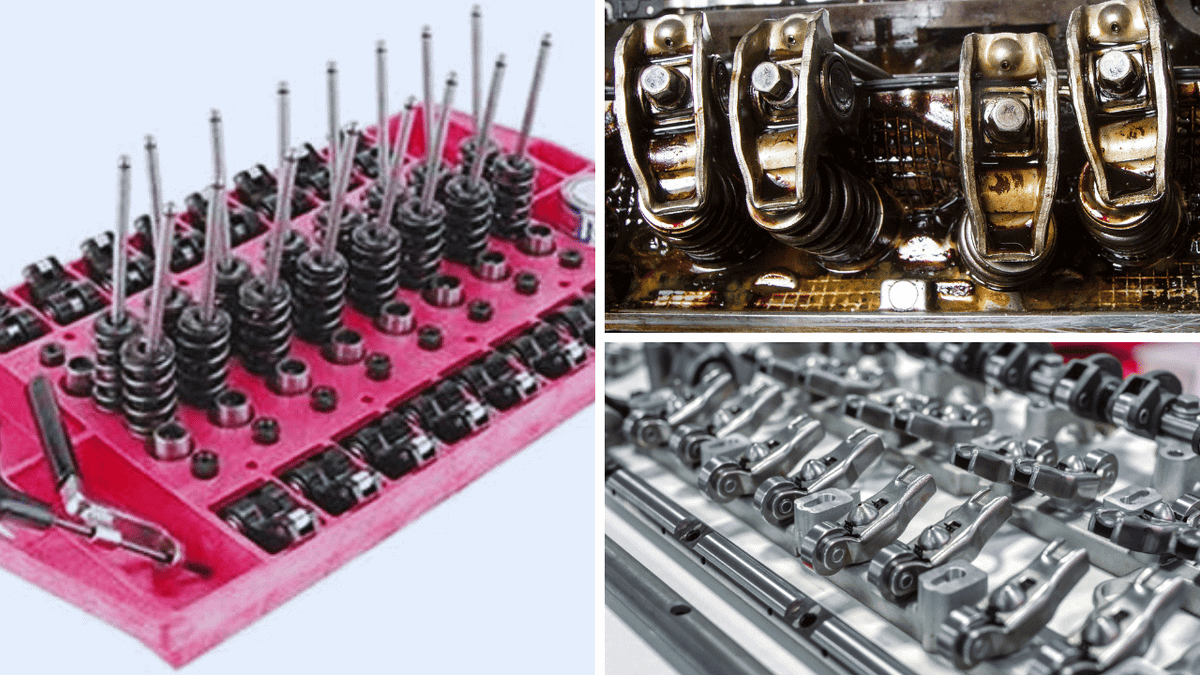
Valve Lash Torque Wrench: How It Works, Why It Matters
A precision valve lash torque wrench ensures accurate settings, protecting engine performance and reducing wear during repairs and tuning.

Fact-checked product review for engine builders, racers, and serious enthusiasts. Specs and street prices verified against manufacturer and retailer listings as of August 2026.
Introduction to Valve Lash, Lash Torque, and the Torque Wrench
If you build or maintain performance engines with solid lifter cams and shaft-style rocker systems, you already know that valve lash can make or break a combination. A valve lash torque wrench is a specialized tool that applies a precise, preset torque to the rocker adjuster nut after you set valve lash clearance, so the setting stays consistent without over- or under-tightening.
Valve lash is the intentional gap between a rocker arm and a valve stem when the lifter sits on the cam's base circle. Too much valve lash clearance can cause engine noise and increased wear, while too little valve lash can keep valves from seating properly, leading to burned valves and serious engine damage. Getting it right matters for power, reliability, and the long-term health of your valvetrain.
Lash torque is the specific torque applied to the rocker adjuster nut after you've dialed in your lash clearance with a feeler gauge. The goal is simple: lock that setting in place without the nut twisting the adjuster screw and changing the clearance you just set. Overtightening a locknut can strip threads and damage engine components, especially aluminum ones.
Undertorque it, and engine vibration can cause the locknut to back off, increasing clearance and throwing your tune out the window. A valve lash torque wrench removes that guesswork, speeds up the adjustment process, and makes repeatable lash settings easier for engine builders, mechanics, racers, and serious automotive enthusiasts.
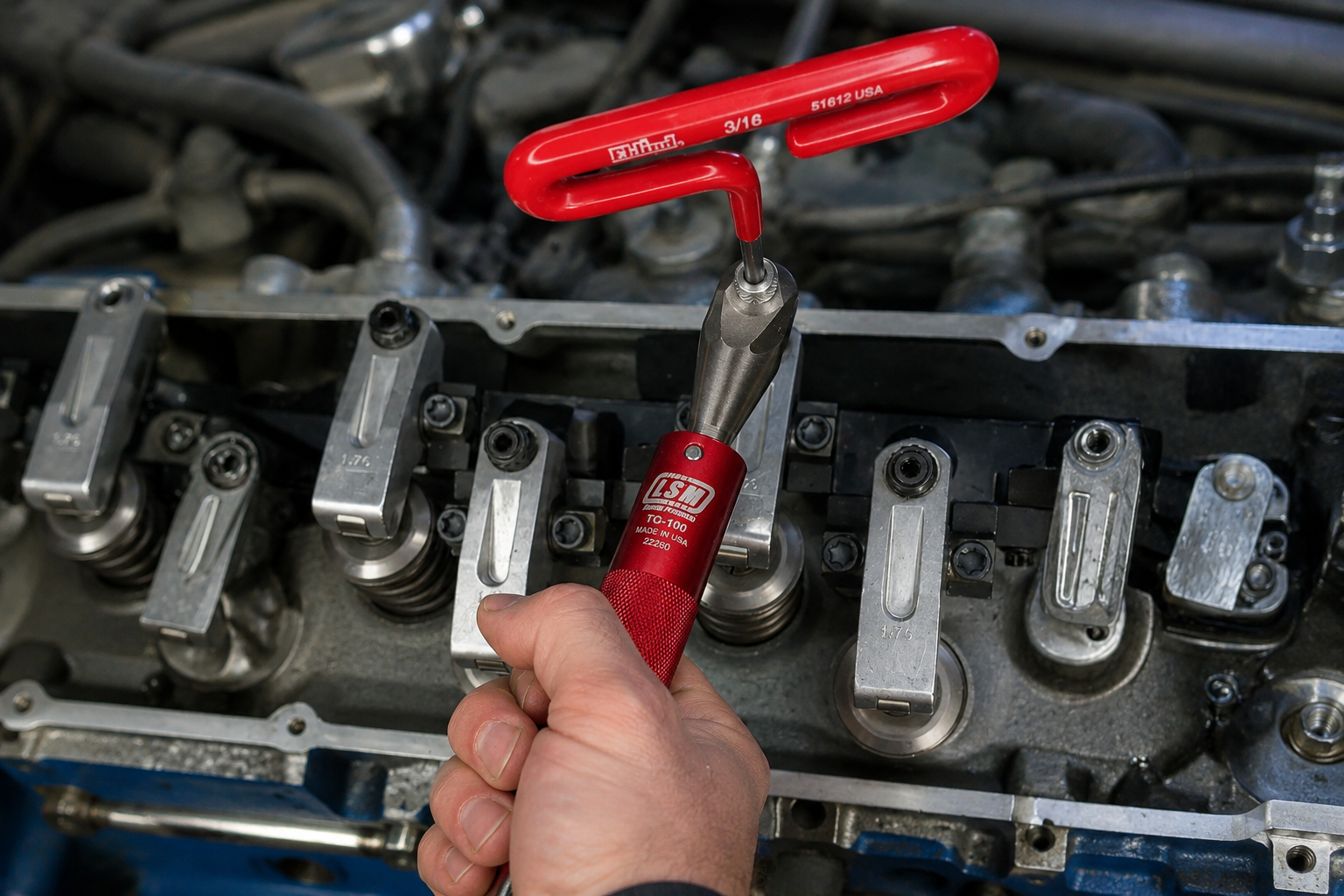
Specialized valve lash torque wrenches, like the LSM valve lash tools and the COMP Cams 5600, solve this problem by combining a preset torque mechanism with an integrated hex drive into a valve adjustment tool. This lets you hold the adjuster screw steady while the wrench torques the nut to a precise, repeatable value.
For those new to engine tuning, think of valve lash torque wrenches as precision tools that help you set and lock the tiny gap between moving engine parts exactly right, so your engine runs smoothly and lasts longer.
This article explains how valve lash works, why lash torque matters, exactly how these tools function, and then reviews two options: the LSM TQ-100KIT, the COMP Cams 5600, and others.
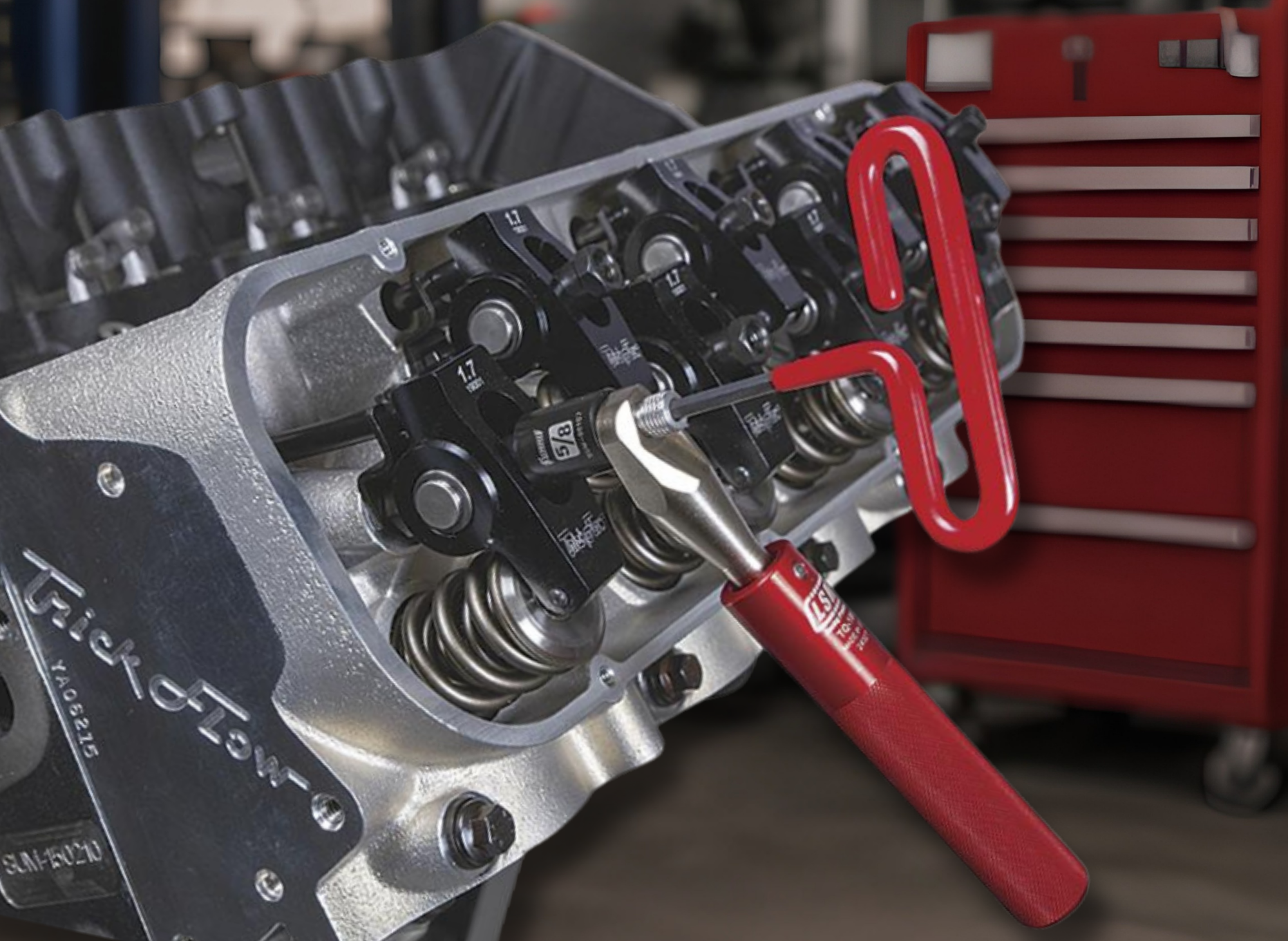
Why a dedicated lash torque wrench belongs in the toolbox:
- Consistent lash across all cylinders. Repeatable settings every time, even under time pressure between rounds.
- Faster adjustments. No juggling a separate torque wrench, hex key, and feeler gauge.
- Reduced risk of damage. Correct nut torque helps prevent stripped threads on aluminum rockers and lash drift from loose locknuts.
Valve lash adjustment is common in older engines with mechanical lifters and high-performance engines running solid roller cams. Many modern passenger cars use hydraulic lifters and typically do not require manual valve lash adjustment.
How a Valve Lash Torque Wrench Works
On a shaft-mounted rocker system, lash is set by threading an adjuster screw in or out of the rocker body until the feeler gauge slips through the gap with slight drag. On stud-mounted systems, you're typically working with a poly-lock or jam nut arrangement. The locking hardware is different: shaft rockers torque the adjuster nut while you hold the screw; polylocks usually lock with an internal set screw. Use the method that matches your hardware.
Different engine types have different valve lash specifications. Typical hot lash values on a solid roller cam might range from 0.016 to 0.024 inches, depending on whether you're setting intake or exhaust, and whether your cam manufacturer's card calls for a tighter or looser baseline. Always follow the cam card, not a generic number.
Most cam cards specify hot lash, meaning the engine needs to be at operating temperature before final adjustments. Cold lash values are often used during initial assembly, then rechecked once the engine warms up, because thermal expansion of the heads, valve stems, and pushrods changes the clearance.
A common starting correction from published hot specs is: iron block and iron heads, add about 0.002 inch; iron block and aluminum heads, subtract about 0.006 inch; aluminum block and heads, subtract about 0.012 inch. Recheck hot after break-in. This is something I do all the time!
Mechanical design of the tool
- Preset torque mechanism. For aluminum shaft-rocker adjuster nuts, the working range is typically 20 to 25 ft-lbs. LSM ships the TQ-100KIT at 22 ft-lbs. Jesel commonly specifies 25 ft-lbs on 3/8-24 adjuster nuts. T&D lists 20 ft-lbs on 3/8 or 7/16 jam nuts. COMP's own lash demonstration uses 20 ft-lbs on polylocks. Confirm the rocker maker's spec and order a custom preset if 22 ft-lbs does not match.
- Through-shaft or offset hex drive. Commonly 5/32 inch or 3/16 inch on shaft rockers, so you can hold the adjuster screw stationary while torquing the nut. Some stud-mount polylock set screws use a 7/32 inch hex instead.
- 3/8-inch drive head. Accepts a standard socket sized to your rocker nut.
Step-by-step usage (shaft-style rockers)
- Rotate the engine until the cam lobe for the valve you're adjusting is on the base circle (heel of the lobe). This unloads the pushrod and lifter.
- Back off the locking nut and adjuster screw. Slip your feeler gauge between the rocker tip and valve stem. Thread the adjuster screw until you feel slight drag on the gauge.
- Insert the hex key through the wrench body and engage the adjuster screw. This holds the screw from turning while you tighten the nut.
- Apply torque with the preset wrench until it clicks at the specified valve lash torque value.
- Recheck the lash with your feeler gauge. If clearance changed when the nut was tightened, repeat.
A torque wrench provides repeatability rather than relying on feel. Consistent clamping load across every valve is where the tool earns its keep.
Why do dedicated lash torque tools sit near 22 ft-lbs
That value is LSM's factory compromise. It is enough clamping force to keep most aluminum-shaft locknuts from backing off under high-RPM valvetrain loads, without overloading aluminum rocker bodies or shaft bushings. It is not universal. Using the wrong torque or a click wrench that has drifted can still overstress aluminum threads or leave a nut loose. Periodically verify calibration. Torque accuracy also changes with thread condition (oiled versus dry), so follow the rocker manufacturer's lube spec.
Disclaimer: torque variance
Published and preset torque figures are starting points, not a guarantee of the clamp load you will actually get on the nut. Actual torque varies with thread lubricant (engine oil versus moly versus dry), thread condition, socket engagement, wrench calibration drift, and whether you are on a shaft-style adjuster nut or a polylock set screw. Jesel notes that the listed values assume 30-weight oil and will be lower with a moly lubricant.
A factory 22 ft-lb preset can also drift after repeated use or if the tool was custom-set by a dealer. Always use the rocker manufacturer's current spec for your exact hardware, recheck valve lash after the nut clicks, and verify the wrench against a known torque standard. When in doubt, call the rocker maker; do not assume 22 ft-lbs is correct for every combination.
Common hex sizes
5/32 inch and 3/16 inch cover the vast majority of shaft-rocker adjuster screws across Jesel, T&D, and Crower. The COMP 5600 also includes 1/8 inch. Some TQ-100-3 kits add 1/8 inch as well. The standard LSM TQ-100KIT does not; it ships 5/32 and 3/16 plus bushings.
Stud-mount polylocks are a different job. LSM designed the TQ-100 for aluminum shaft rockers. You can adapt it to a polylock set screw with a 3/8-inch drive hex bit (often 7/32 inch) and a box wrench, but do not treat the haft-nut procedure and polylock procedure as interchangeable.
LSM, COMP Cams, Valve Lash Wrench
All options below are built around the same job: applying precise, repeatable lash torque on solid-lifter and shaft-rocker applications. The differences come down to build quality, documented torque values, included accessories, price, and whether you are buying from the manufacturer or a third-party listing.
LSM wrenches combine a precision torque wrench with a built-in valve-adjustment hex, so you are not juggling a click wrench, a hex key, and an open-end wrench. The COMP Cams 5600 takes a similar approach with a steel body and a broader hex-key selection.
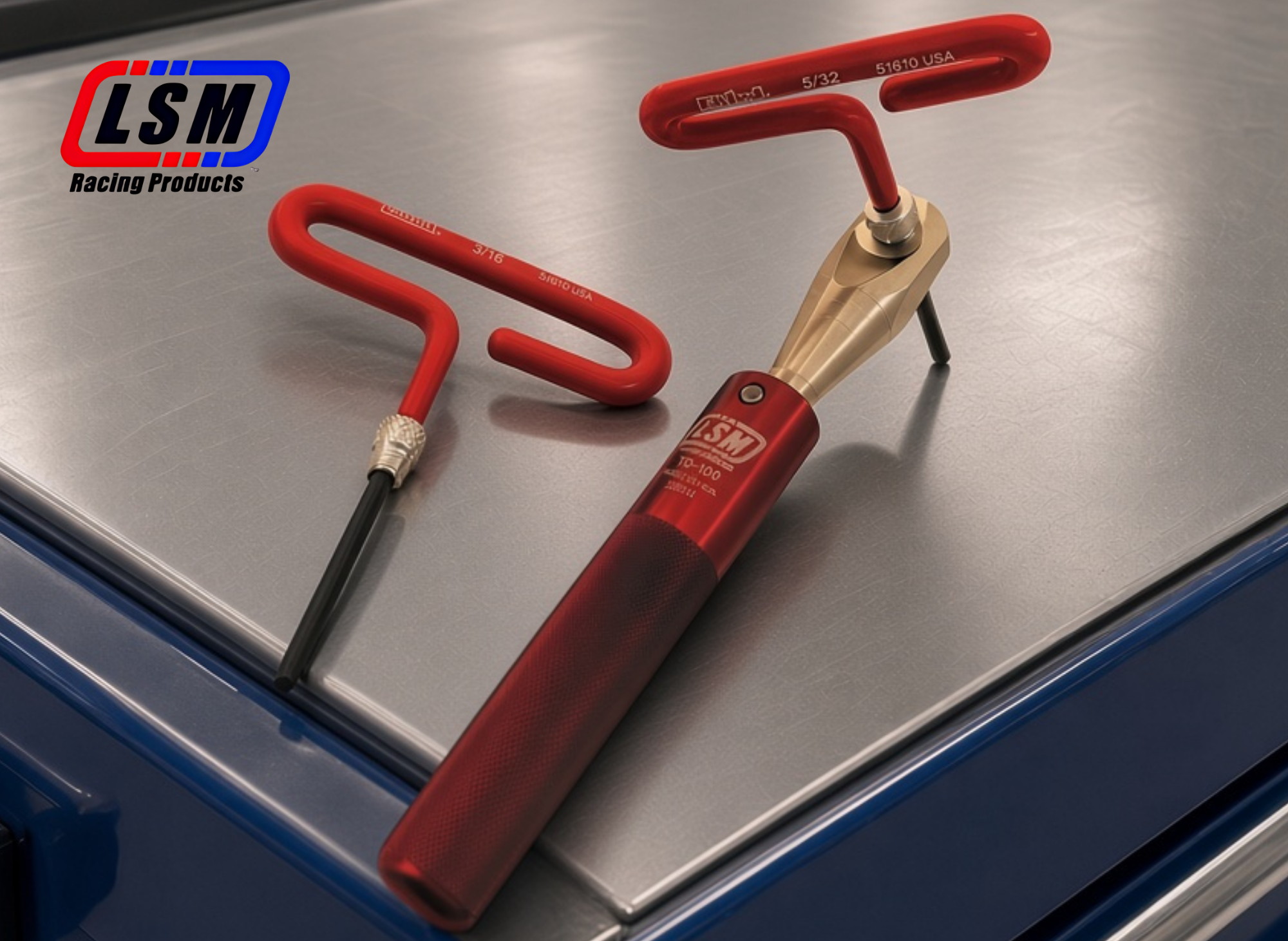
LSM Racing Valve Lash Torque Wrenches TQ-100KIT
Wrench, Valve Lash, 3/8 in. Wrench with 3/16 in., 5/32 in. T-Handles, Aluminum, Red, Kit
LSM Valve TQ-100KIT Lash Torque Wrench
The LSM TQ-100KIT is purpose-built for aluminum shaft-style rocker systems. It is a 7.750-inch, red-anodized aluminum tool with a knurled, non-slip handle that stays planted in oily hands. The wrench ships with 5/32 and 3/16 inch Allen hex keys and adapter bushings, and its 3/8-inch drive head accepts any standard socket for your specific rocker nut. The socket is not included. LSM lists the kit at $224.99.
These wrenches are compatible with aluminum shaft rocker systems from Jesel, T&D, and Crower. The standard TQ-100KIT ships preset to 22 ft-lbs. LSM will custom-set the tool from 13 to 26 ft-lbs if you note the request when ordering; some retailers list the custom window as 13 to 28 ft-lbs.
LSM's own adjustment sheet says not to exceed 28 ft-lbs on a TQ-100. If you need more clamping force, steel rockers, blown alcohol, or fuel combinations, LSM makes the TQ-200, which can be set as high as 45 ft-lbs.
This valve lash torque wrench offers a balance of precision and accuracy and is priced at $224.95. It is designed for accurate torque application to rocker adjuster nuts, ensuring consistent valve lash settings and preventing damage from over- or under-tightening. The LSM TQ-100-3 is set at 28-30 lbs of torque.
Pros:
- Professional-grade build quality with durable red-anodized aluminum.
- Consistent, reliable click at preset torque.
- Compact head design fits tight engine bays.
- Includes 5/32- and 3/16-inch hex keys with adapter bushings.
- Custom preset torque options are available.
Cons:
- A higher price point ($224.99) may deter casual users.
- Sockets for rocker nuts are sold separately.
- A single preset torque limits flexibility unless multiple tools or resets are purchased.
Best For: Racers, engine builders, and dyno sessions requiring precise, repeatable lash torque adjustments.
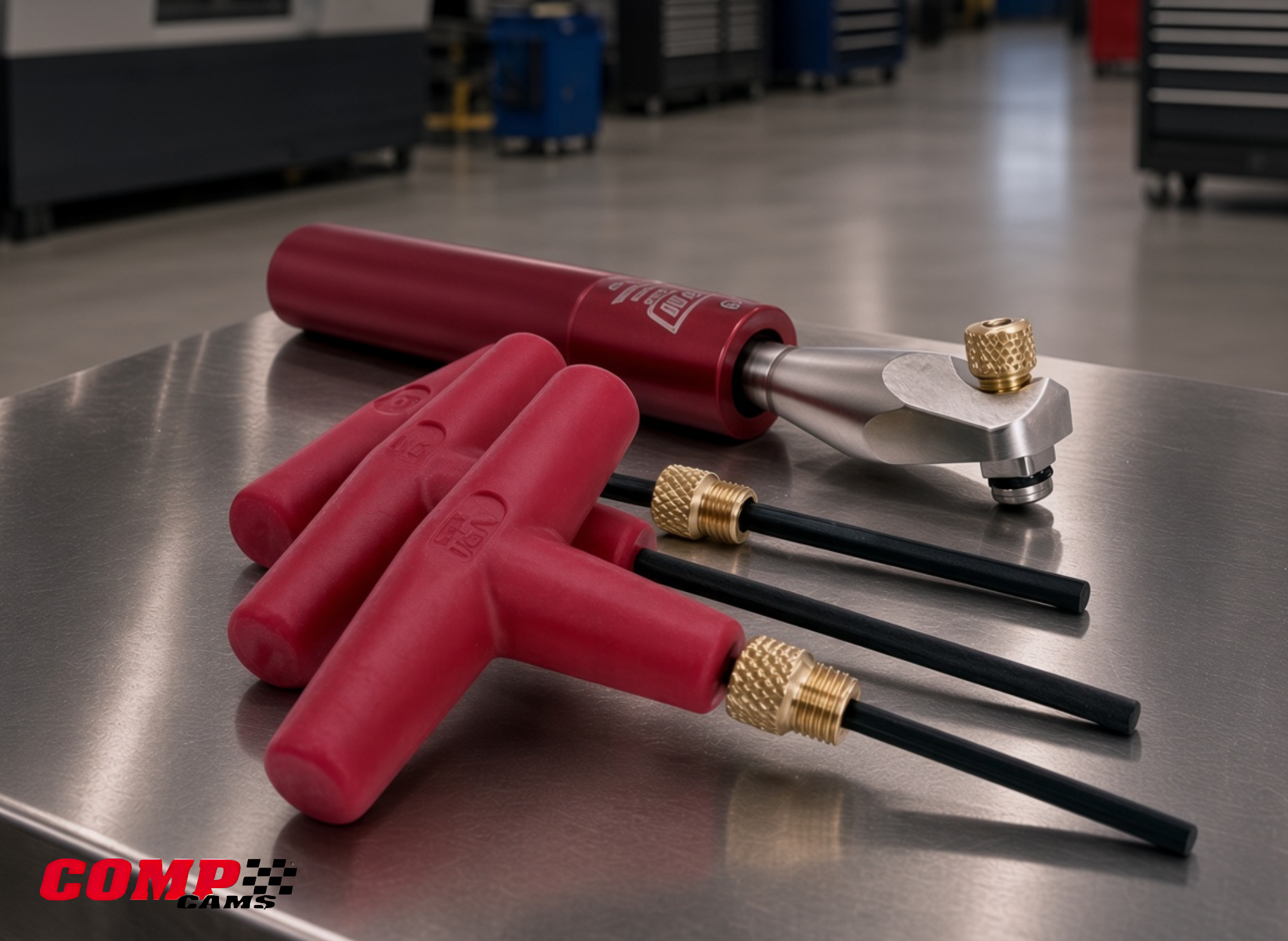
COMP Cams Valve Lash Adjustment Torque Wrenches 5600CPG
Valve Lash Adjusting Torque Wrench, Steel, Red, T-handles, Kit
COMP Cams 5600 Valve Lash Adjusting Wrench Set
The COMP Cams 5600 (5600CPG) takes a more rugged approach. Built from steel rather than aluminum, it is heavier but better suited to shop environments where tools get dropped and stacked. It ships with three T-handle hex key sizes, 1/8, 5/32, and 3/16 inch, and uses the same 3/8-inch drive socket interface as the LSM tools. Street pricing typically ranges from $247.95 to $249.95. Some dealers still show list prices in the $314 to $348 range; budget the street number, not the list number.
The steel construction enhances longevity, and the T-handle hex keys are easier to grip than bare Allen keys when working around hot manifolds. It covers the same shaft-rocker adjuster sizes as the LSM kit, plus 1/8 inch. COMP does not publish the exact preset torque on the product page.
The company describes it as an industry-standard spec. COMP's own how-to video clicks the wrench at 20 ft-lbs on polylocks. If your rocker card calls for 25 ft-lbs, confirm the 5600's actual setting before you use it as gospel on aluminum shaft nuts.
Sockets are not included. The extra weight can be a drawback during long sessions or overhead work.
Pros:
- Durable steel construction for heavy-duty shop use.
- Includes 1/8, 5/32, and 3/16 inch T-handle hex keys.
- T-handle design improves grip and comfort.
Cons:
- A heavier tool may cause fatigue during prolonged use.
- Socket not included.
- Exact torque preset not explicitly published.
Best For: Heavy-duty shop environments and users who need a broader hex key range.
Quick Comparison
Feature | LSM TQ-100KIT | COMP Cams 5600 |
|---|---|---|
Body material | Aluminum | Steel |
Preset torque | 22 ft-lbs (custom 13–26; do not exceed 28 on a TQ-100) | Unpublished; COMP demo uses 20 ft-lbs on polylocks |
Hex keys included | 5/32, 3/16 | 1/8, 5/32, 3/16 |
Drive size | 3/8 in. | 3/8 in. |
Socket included | No | No |
Approx. street price | $224.99 | $247.95–$249.95 (some list $314–$348) |
Best for | Shaft-rocker race/shop use and custom presets | Heavy-duty shop use and extra 1/8 in. hex |
FAQs
Why is valve lash adjustment important?
Proper valve lash ensures valves open and close correctly, preventing engine noise, wear, and potential damage.
Can I use a regular torque wrench for valve lash?
Regular torque wrenches lack the integrated hex key and preset torque needed for precise, repeatable valve lash adjustments.
How often should valve lash be checked?
It depends on engine use, but racers and high-performance engines often require regular valve lash checks, while typical street engines with hydraulic lifters rarely need adjustment.
What happens if valve lash is too tight or too loose?
Too tight can prevent valves from seating, risking damage; too loose leads to noise and increased wear.
Are these tools compatible with all rocker systems?
They are primarily designed for shaft-style rocker systems; stud-mount polylocks require different tools or adapters.
Different engine types may have varying valve lash specifications.
Bottom Line
Whether you're setting lash cold during assembly and rechecking it hot at the track, or running through a batch of engines on the dyno, a dedicated valve lash torque wrench removes the biggest variable from the process: inconsistent nut torque.
Match the tool to your hardware, verify the preset against the rocker manufacturer's spec (often 20 or 25 ft-lbs, not automatically 22), and recheck clearance after the nut clicks.
Remember that real-world torque still varies with lube, thread condition, and tool calibration; the wrench is only as accurate as those conditions allow. The cost of any of these tools is a fraction of the cost of replacing a burned valve or a cracked aluminum rocker from a locknut that either backed off or was wrenched too tight at 8,000 RPM.
A precision valve lash torque wrench delivers exact torque for setting engine valve clearance, helping mechanics and DIY tuners protect performance and prevent costly wear.
Thank you for reading!
Your friend,
Todd
#ValveLash 🔧 #TorqueWrench ⚙️ #EngineAdjustment 🚗 #AutoTools 🛠️ #MechanicLife 💪 #DIYCarRepair 🔩 #PrecisionTools 📏 #EngineMaintenance 🏁 #CarEnthusiast 🔥 #ShopEssentials 🧰
This site contains affiliate links, and we may earn a commission at no extra cost to you. All recommended products are thoroughly vetted.
 Todd Bandel
 Todd Bandel
 Todd Bandel
 Todd Bandel
 Todd Bandel