AMC AMX: The Two-Seat American Muscle Car Icon
A must-have for classic car lovers! Check out this book on the AMC AMX.

The AMC AMX occupies a singular space in automotive history. Built by American Motors Corporation from 1968 to 1970, this two-seat sports car dared to challenge the Corvette and every other muscle car rolling out of Detroit during the golden age of American performance. With only 19,134 AMC AMXs built across all three model years, collector interest has surged, and the car's legend only grows with time.
Quick Overview: What Is the AMC AMX?
The AMC AMX was a two-seat American muscle car built by American Motors Corporation for the 1968, 1969, and 1970 model years- a compact, high-performance two-seater created to challenge the Chevrolet Corvette while standing apart from every pony car in dealer showrooms. It shared its basic architecture with the AMC Javelin but used a shorter wheelbase and deleted the back seat entirely, giving AMC a true two-seat layout that no Mustang or Camaro rival could match.
AMC designed the AMX as a direct challenge not only to the Corvette but also to contemporary performance cars from Ford, Dodge, and Pontiac. The result was an aggressive coupe with genuine V8 power at a price that undercut most rivals. Total production across all three years reached approximately 19,134 units-split roughly 6,725 in 1968, 8,293 in 1969, and 4,116 in 1970-making it far rarer than the Mustang or Camaro of the same era, and a far more distinctive target for collectors, enthusiasts, and historians interested in unusual American performance cars.
For sports car enthusiasts, muscle car collectors, automotive historians, and buyers curious about owning one today, the AMX remains important because it shows how a smaller automaker built a rare, historically significant alternative to Detroit's mainstream muscle machines.
This guide examines the AMC AMX's history, design, engineering, performance specifications, special and limited editions, racing heritage, global variants, collector values, driving experience, and what to know before buying, owning, or driving one now.
It is worth noting that the abbreviation AMX appears in several unrelated contexts: AMX provides AV signal distribution and automation control systems for commercial environments, AMX is the ticker symbol for América Móvil on the NYSE (a major telecommunications corporation in Latin America), and the Amsterdam Midkap Index tracks mid-cap stocks on Euronext Amsterdam. This article, however, focuses entirely on the classic car.
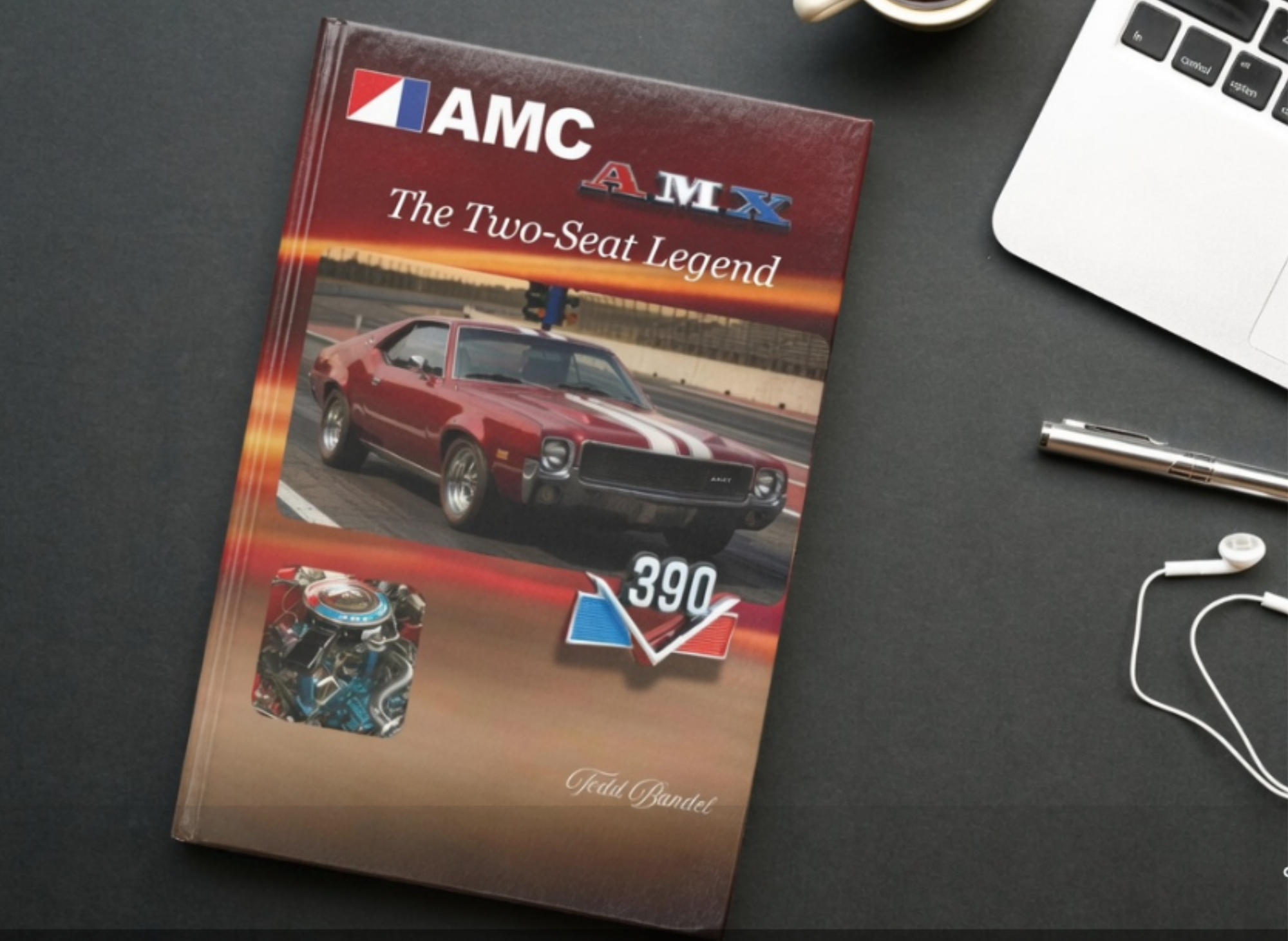
AMC AMX: The Two-Seat Legend
Discover the mechanical grit and brilliant structural surgery that allowed an underfunded engineering team to build a short-wheelbase monster capable of shattering Detroit's dominance.
American Motors Corporation and the Birth of the AMX
American Motors was formed in 1954 through the merger of Nash-Kelvinator and Hudson, and by the mid-1960s it stood as the smallest of the traditional Big Four U.S. automakers. For years, AMC had been associated with sensible economy compacts-the Rambler line dominated its sales charts-but leadership recognized that the company needed to shed its economy car image if it wanted to attract younger, performance-hungry buyers.
The strategy shift came under President Roy D. Chapin Jr., who pushed AMC toward youth-oriented cars. Design chief Dick Teague, one of the most talented stylists in America, and AMC's designers were tasked with creating a lineup that could compete visually and dynamically with anything from General Motors or Ford. The Javelin, launched in 1968, was the opening salvo. The AMX was the knockout punch: a dedicated two-seat version that would serve as AMC's halo performance car.
Internal project goals were pragmatic. Engineers needed to leverage existing Javelin underpinnings to keep development costs manageable while delivering a compact, affordable machine that could genuinely rival the Corvette on appeal.
The result was a car that used the Javelin's front subframe, rear end, and many body panels, but chopped the wheelbase down and eliminated the rear seat to create something entirely different in character; those compact proportions helped it feel small and purpose-built compared with larger muscle cars. It was a bold move from a company that most guys on the street associated with station wagons.
Concept Cars: From AMX I to AMX II, GT, and AMX/3
Before any steel-bodied cars reached production, AMC tested the waters with a series of concept vehicles that ranged from theatrical to surprisingly close to the final product.
The story begins with the 1966 AMX concept, unveiled at the Society of Automotive Engineers convention and the New York Auto Show. This fiberglass-bodied show car featured a dramatic "Ramble Seat" that folded out of the rear deck at the push of a button, with a special body panel treatment around the opening, plus a split-vee windshield and a pillarless roofline. It was pure fantasy, but it captured public attention and proved that AMC could generate excitement. The concept was part of AMC's broader Project IV series of experimental show cars.
The AMX II and AMX GT concepts, shown during 1966–1967, moved progressively closer to a realistic production form. These designs previewed the proportions and profile that would define the eventual production car and the Javelin, trading the wilder show-car elements for something a factory could actually build. The AMX II in particular helped establish the long-hood, short-deck silhouette that became the car's signature. George Barris–linked customization kits for AMC products further signaled that the company welcomed aftermarket personalization even at the concept stage.
The most exotic chapter belongs to the mid-engined AMX/3 supercar program. Designed by Dick Teague with Italian coachwork from Bizzarrini and engineering assistance from BMW, the AMX/3 used a 390 V8 mounted behind the seats. Only five or six examples were completed before rising costs and tightening U.S. safety and emissions regulations killed the program. It was as close to a Ferrari-fighter as any American manufacturer attempted in that era, and its cancellation remains one of the great "what-ifs" of automotive history.

Design and Engineering: A Compact Two-Seat American Muscle Car
The production AMX, introduced for the 1968 model year, shortened the Javelin platform by roughly 12 inches to achieve a 97-inch wheelbase. That shorter wheelbase, combined with the deletion of the back seat, created a true two-seat coupe with a body style unlike anything else in America's muscle car landscape. The trunk capacity of the AMX measured 9.7 cubic feet (275 L)-modest trunk space, but sufficient for weekend trips.
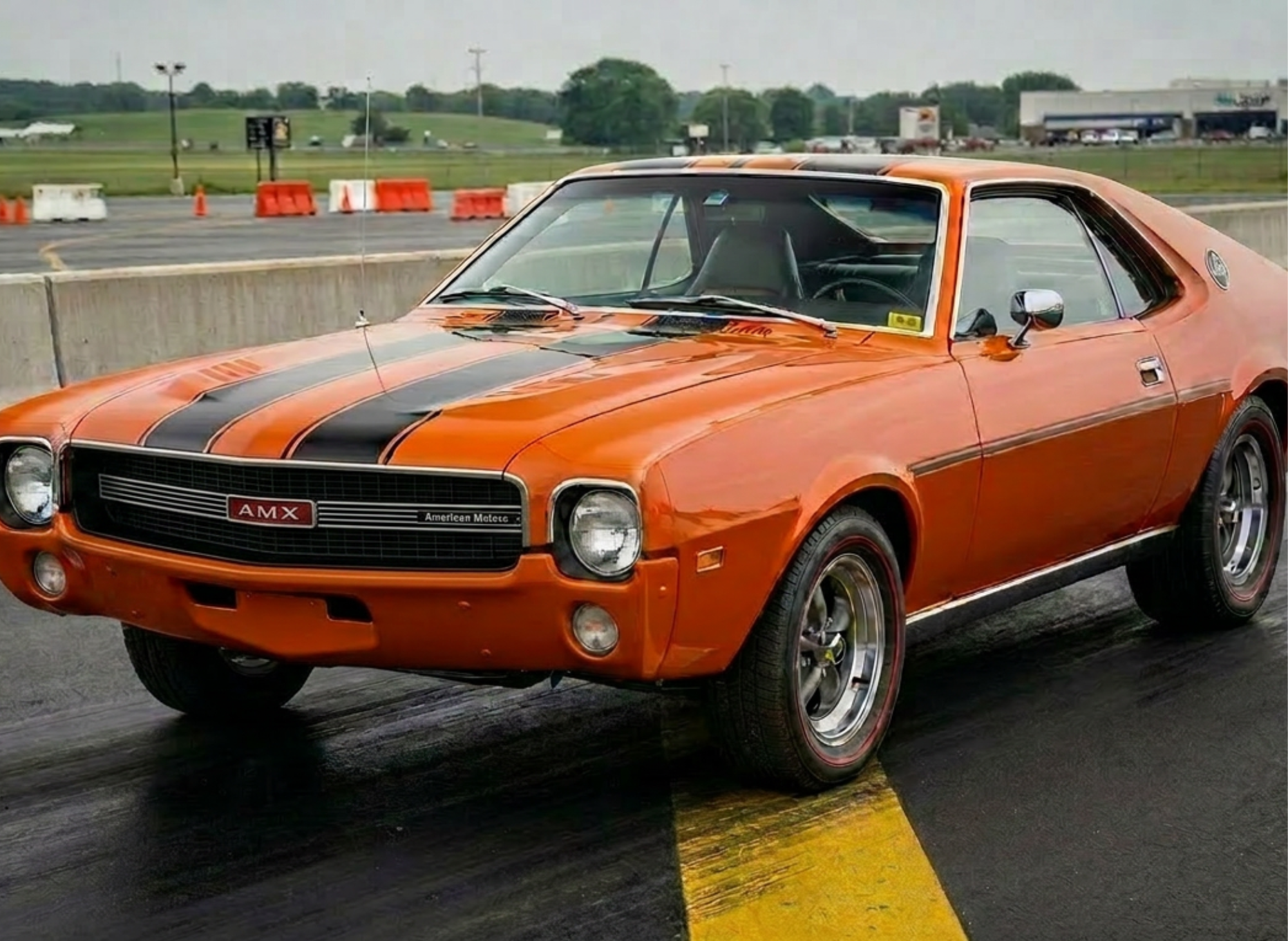
Exterior design emphasized a long-hood, short-deck profile with a fastback roofline and minimal overhangs. A prominent character line ran the length of the body, giving the car a purposeful, taut stance that made larger muscle cars look bloated by comparison. The front end carried a simple grille treatment that evolved across model years.
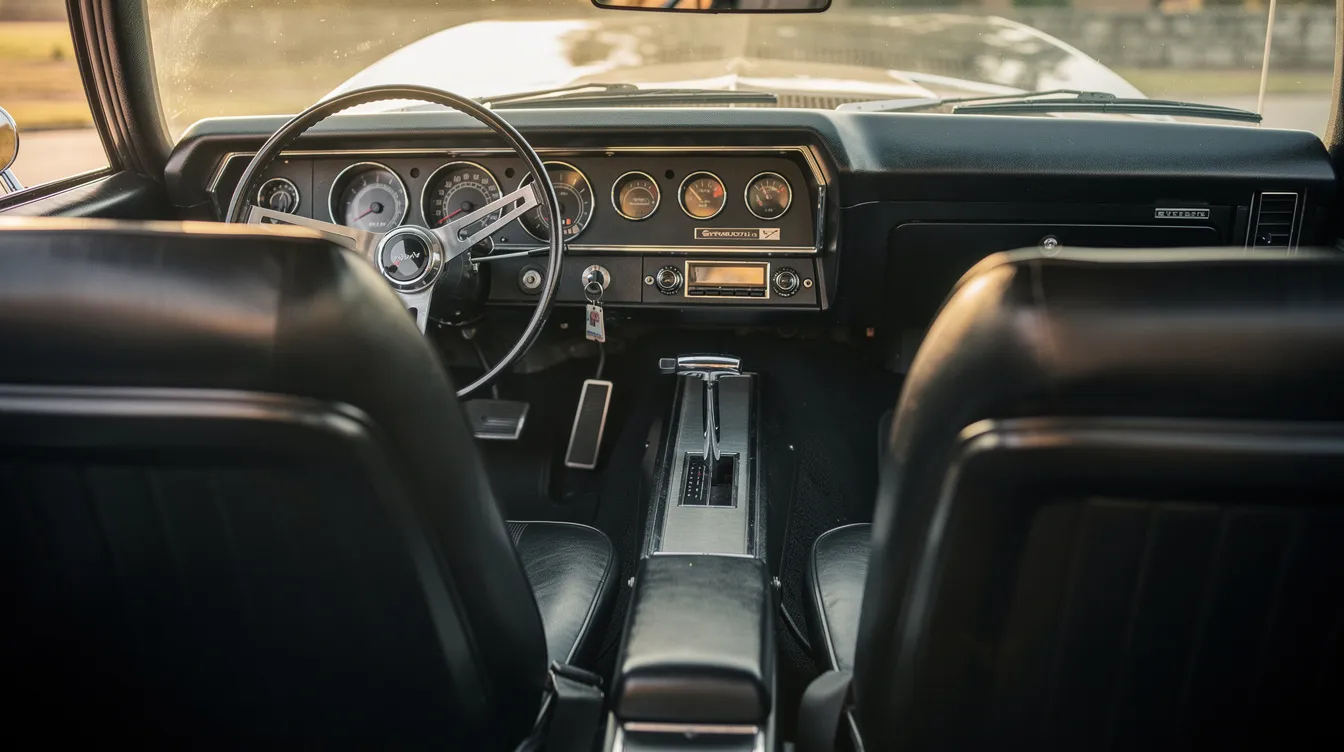
Inside, the cabin featured bucket seats, a sporty dashboard with round gauges, and an available center console. Later model years added options like leather upholstery, upgraded carpeting, revised door panels, and comfort features including air conditioning and tilt-wheel steering.
The chassis used front independent coil springs with parallel A-arms and a conventional live axle with leaf springs at the rear. Curb weight landed around 3,100 pounds, depending on equipment—lighter than most full-size muscle cars and noticeably more agile. AMC also invested in structural engineering, using high-strength steel in the passenger cell and marketing the car's safety features alongside its performance credentials.
Engines, Performance, and the Go Package
The two-seat AMX offered a compelling range of V8 engine choices across its short production run.
1968–1969 engine lineup:
The 1969 AMC AMX with the 390-cubic-inch V8 engine produces 315 horsepower and 425 lb-ft of torque-serious numbers for a car weighing just over 3,100 pounds. For 1970, the 290 and 343 were dropped in favor of a new 360 cubic inch V8 (around 285 hp), while the 390 received a revised rating of approximately 325 hp.
Transmission options include a four-speed manual transmission with Hurst floor shifter or an optional three-speed shift-command automatic. The four-speed manual delivered a more visceral driving experience, while the automatic suited buyers who wanted relaxed cruising with strong acceleration on demand.
The factory go package bundled the hardware that turned the AMX from quick to genuinely fast: power front disc brakes, heavy-duty suspension with stiffer springs and shocks, Twin-Grip limited-slip differential, performance gearing, upgraded cooling, and, on 1970 models, optional functional ram-air induction.
With the Go package and the 390 engine, the AMX achieved a 0-60 mph time of under 7 seconds and ran the quarter mile in the mid-14-second range at roughly 95 mph in contemporary magazine testing.
Compared to rivals, the AMX offered a high-performance version of the two-seat formula at a lower price than the Corvette, with more exclusivity than the Mustang or Camaro. It was a value proposition that deserves more attention than it typically receives.
Year-by-Year Breakdown: 1968, 1969, and 1970 AMX Model Years
The first-generation AMX spanned just three model years, each bringing refinements that kept the car competitive.
1968 marked the AMX's debut. The car was first shown at the Chicago Auto Show in February 1968 and reached dealer showrooms shortly after. The base price started around $ 3,245, thousands less than a comparable Corvette. Engine options covered the 290, 343, and 390 V8S.
A handful of promotional cars were finished in "Playmate Pink" as part of a Playboy tie-in, making them curiosities today. Standard equipment was relatively spartan, but the options list allowed buyers to build a serious performance car with a manual transmission, disc brakes, and the go package. Total sales were 6,725 for the year.
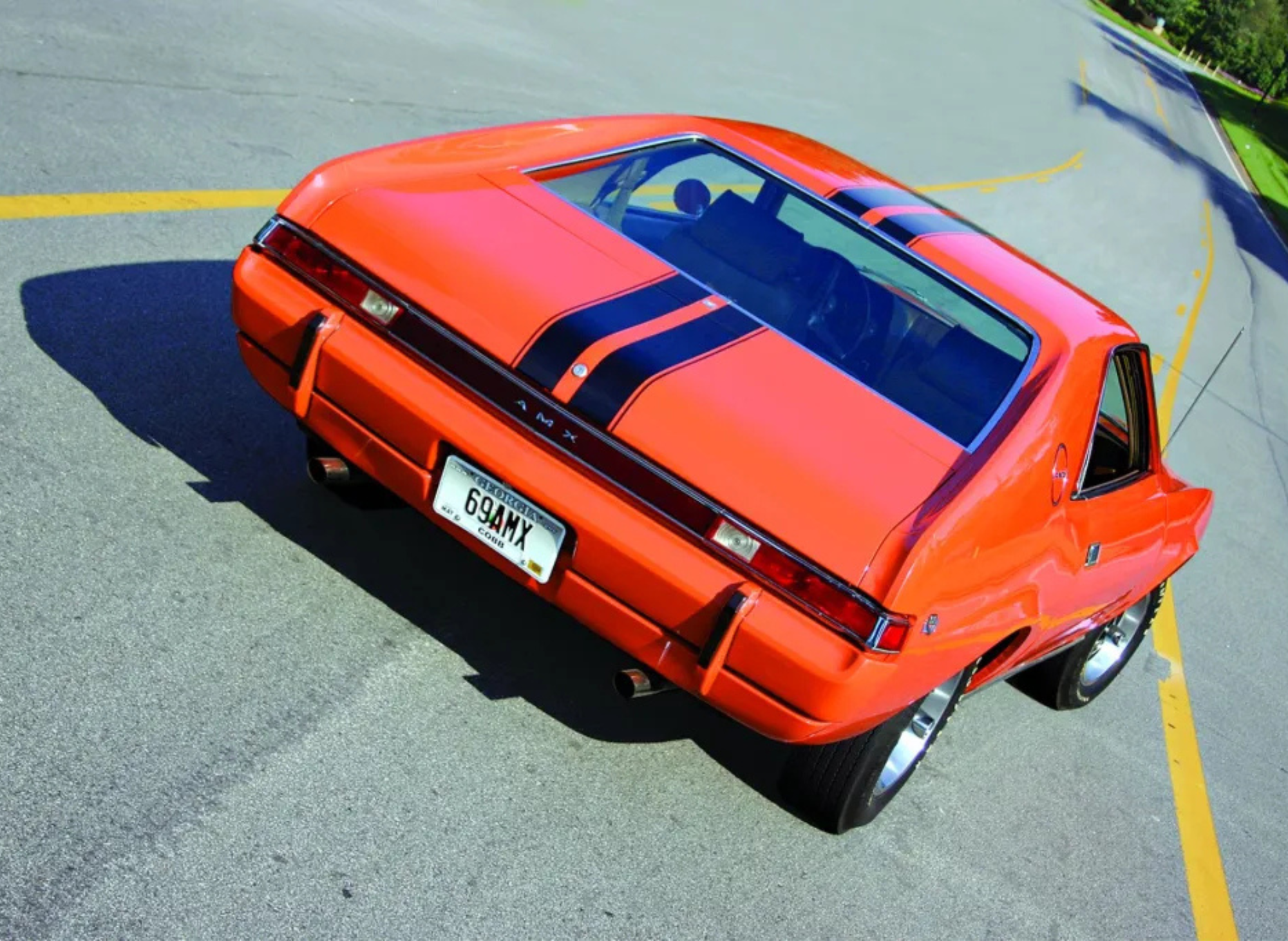
1969 brought the highest production volume at 8,293 units. Styling updates included revised interior door panels, upgraded carpeting, optional leather upholstery, and a new suspended gas pedal. The same engine trio carried over. The headline news was the introduction of the big bad color options-big bad orange, big bad green, and Big Bad Blue-which featured color-keyed bumpers and trim instead of chrome.
These vivid paint option choices gave the car a more aggressive visual identity and are highly prized today. On June 29, 1969, AMXs also served as pace and courtesy cars for the Pikes Peak International Hill Climb, giving the model year added motorsport visibility. Vince Gardner, an AMC dealer personality in the period, was among those championing the car's performance image.
1970 was the final year for the two-seat version. Production dropped to 4,116 units. The front end received a new grille, chrome bumpers replaced the earlier color-keyed units, and a power blister hood with optional ram-air debuted. The 360 V8 joined the lineup while the 290 and 343 were discontinued. Interior materials were refreshed, and stricter emissions and safety equipment became standard.
Special and Limited Editions: Von Piranha, California 500, Super Stock AMX
Limited-edition and dealer-modified AMXs form the most collectible tier of the car's legacy. Some of these special editions are so rare that surviving owners barely know of each other's existence.
The Von Piranha AMX was created by Thoroughbred Motors, with roughly 22 cars modified from 390 Go Package–equipped 1968–1969 AMXs. Modifications included C-pillar and roof air scoops, functional cuts in the twin hood bulges for increased engine airflow, reworked rear bumpers, and AMC Group 19 R4B aluminum intake manifolds stamped with the Von Piranha logo. A 950 CFM Holley carburetor topped the engine. These cars were set up for both road racing and quarter-mile duty, and only a handful of verified survivors exist today.
The 1969 California 500 Special was a dealer-created edition from Southern California AMC dealers, built to celebrate the California 500 Indy-style race at Riverside. All were finished in Big Bad Green with black stripes and equipped with 390 Go Package engines, saddle leather interior trim, and upscale features: power steering, power front disc brakes, factory air conditioning, tinted glass, AM/FM radio, and "Trendsetter Sidewinder" side-exit exhausts. Brass plaques with crossed checkered flags adorned the hood blisters. Only an estimated 32 were built. In 2006, a California 500 AMX sold for $54,000-a figure that has only climbed since, with high-profile Arizona auctions helping confirm the strong market for rare AMXs.
The Super Stock AMX (SS/AMX) consisted of 52 cars pulled from the Kenosha assembly line and modified via Hurst in Michigan for NHRA Super Stock drag racing. All were Frost White with stripped interiors, 390 four-speed powertrains, 4.44:1 rear axles, and heavy-duty mechanicals. AMC officially rated them at 340 hp, but the NHRA re-factored the 390 engine to approximately 420 hp based on actual performance. Shirley Shahan, known as the "Drag-On Lady," campaigned one of these cars. They entered NHRA Super Stock competition as factory-backed drag-racing specials.
Racing Heritage: Drag Strips, SCCA, and Endurance Records
AMC understood that motorsport credibility was essential to positioning the AMX among leading muscle cars, and the company invested accordingly—though these efforts are rarely acknowledged in mainstream automotive histories. AMC campaigned the AMX in a variety of motorsport settings, from road racing to drag strips, before its role in SCCA competition came into sharper focus.
In SCCA competition, the AMX was classified in SCCA B Production racing, where its combination of light weight and strong V8 power made it competitive against established rivals. AMX-based entries scored solid results through the late 1960s, complementing the Javelin's higher-profile Trans-Am campaigns. Well-known drivers associated with AMC racing programs-including Peter Revson and Mark Donohue-primarily drove Javelins, but AMXs also saw track time in production-class events.
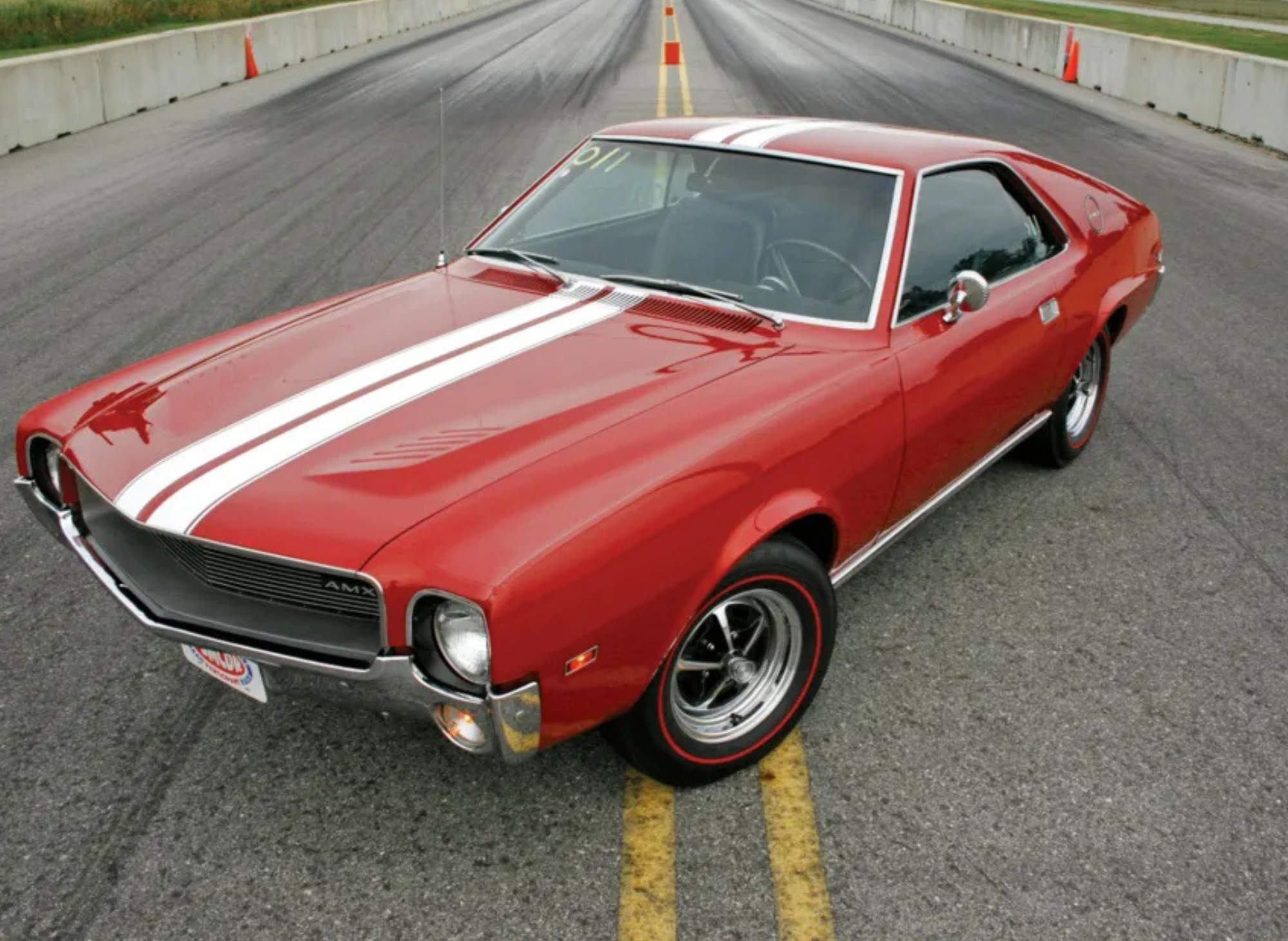
Drag racing showcased the car's straight-line ferocity. Shirley Shahan and Wally Booth ran AMXs in NHRA categories, turning heads with a car that most competitors dismissed as an underdog. The AMX achieved a quarter-mile time of 10.73 seconds in prepared Super Stock trim-a figure that earned respect at any strip in the country.
Craig Breedlove's high-speed endurance runs at Goodyear's Texas test track in early 1968 generated massive publicity. AMXs set over 100 class speed and endurance records during these runs, and AMC leveraged the results aggressively in advertising. The car also appeared in the 1971 and 1972 Cannonball Baker Sea-to-Shining-Sea Memorial Trophy Dash, further cementing its long-distance, high-speed credentials. These endurance records showed the car's durability and high-speed capability beyond straight-line acceleration.
The AMX even served as a pace car at various racing events, adding another layer of motorsport visibility for a brand that desperately needed it.
Global Variants: Australian Motor Industries (AMI) AMX
On the other side of the world, Australian Motor Industries (AMI) in Melbourne assembled a tiny number of right-hand-drive AMXs from Complete Knock Down kits shipped from Kenosha, Wisconsin. A total of 24 right-hand-drive AMXs were assembled in Australia between August 1969 and July 1970, making these among the rarest AMX variants on Earth.
Australian AMXs featured hand-assembled construction, fiberglass right-hand-drive dashboards with wood-grain instrument panels, distinctive door panels and seats, and standard fitment of power steering and power front disc brakes. Mechanical differences from U.S. models included non-reversed windshield wipers, swapped positions of the heater and brake booster, and local compliance equipment required by Australian regulations.
The color palette was limited to just three choices: White, Safety Wattle Yellow, and Signal Red. A black vinyl detail inside the "AMX" C-pillar logo distinguished these cars from American-market versions.
AMI marketed the cars as "personal super cars" in Australian advertising-a phrase that captured the AMX's essence perfectly. Today, surviving Australian RHD AMXs command significant premiums among collectors worldwide. Their combination of extreme rarity, unique right-hand-drive configuration, and hand-built character makes them the ultimate prize for dedicated AMX enthusiasts. Locating one for sale is an event in itself.
From Two Seats to Four: The Javelin-Based AMX After 1970
The dedicated two-seat AMX ended production after the 1970 model year. For 1971, AMC repositioned the AMX name onto the second-generation Javelin, creating a four-seat performance car rather than a strict two-seater.
The reasons behind this shift fell into two camps. On one side, slowing sales of pure two-seat cars and tightening insurance rates on high-performance models made the dedicated AMX increasingly difficult to justify. On the other hand, AMC needed to maximize production volume by basing its performance variants on mainstream platforms rather than niche, low-volume body styles.
The 1971–1974 Javelin-based AMX featured a four-seat layout with available 304, 360, and 401 cubic-inch V8 engines. Its styling was aggressive-pronounced fender flares and "tumblehome" rear glass gave it a muscular presence-but it was fundamentally a different kind of car than its predecessor. Later still, the late-1970s and early-1980s Spirit-based AMX models used the name primarily for appearance and handling packages on sporty compact hatchbacks, a far cry from the original's raw performance character.
Collectors and historians draw a clear line: "first-generation AMX" or "original AMX" refers specifically to the 1968–1970 two-seat cars. The Javelin AMX and Spirit AMX are recognized as separate generations, each with its own appeal, but neither carries the same mystique as the original two-seat version.
Buying Guide: Values, Rarity, and What to Look For
The average sale price of an AMC AMX currently sits around $51,529. Still, according to collector-market tracking from Hemmings and recent auctions, that number masks enormous variation depending on specification, condition, and provenance. Project cars needing comprehensive restoration can be found in the $15,000–$30,000 range, while the top sale price for an AMC AMX reached $280,500 for a pristine, highly documented example.
Recent auction results illustrate the trajectory: in 2020, a 1969 AMX sold for $43,500 on a major online platform, while top-condition cars with rare specifications have since pushed well into six-figure territory, and standout colors and special editions help certain cars stand out in the market. The market rewards specifics.
Factors that drive value:
- Engine size: the 390 cubic-inch V8 commands the strongest premiums
- Go package equipped cars outperform base models significantly
- A four-speed manual is preferred over the three-speed automatic
- Rare colors like Big Bad Orange or California 500 Big Bad Green add substantial value
- Special editions (Von Piranha, Super Stock, AMI RHD) are in a class of their own
- Documentation-build sheets, dealer invoices, ownership history-can add thousands
Inspection checklist:
Parts availability has improved thanks to AMC specialty suppliers, enthusiast forums, and reproduction manufacturers, but some AMX-specific items-dash pads, certain exterior trim pieces, and special-edition plaques-remain rare and expensive. For insurance, always use agreed-value or guaranteed-value policies and have the car professionally appraised, particularly for special editions. Well-documented vintage examples with rare factory specs attract the strongest collector interest.
For deeper research, the book AMC AMX: The Two-Seat is a comprehensive reference covering production data, specifications, and collector guidance for all three model years. Sources: auction results, Hemmings market coverage, and marque references used for valuation research.
Driving and Owning an AMC AMX Today
Behind the wheel of a well-sorted two-seat AMX, the experience is immediate and mechanical in ways that modern performance cars simply cannot replicate. The V8 delivers strong low-end torque, the relatively light curb weight rewards quick inputs, and the shorter wheelbase produces sharp turn-in that surprises drivers accustomed to longer-wheelbase muscle cars. It is not just that the car is fast-it feels alive.
The 97-inch wheelbase can make the car nervous on broken pavement or at sustained highway speeds. Careful suspension setup, including modern shocks, correct alignment, and quality tires, dramatically improves both ride and handling without sacrificing visual originality.
Fuel economy generally lands in the low teens, and modern traffic demands attention to cooling and braking. Sympathetic upgrades like dual-circuit master cylinders, improved radiators, or electronic ignition are common among owners who drive their cars regularly.
The community aspect is a genuine highlight. Active AMC clubs, AMX-specific gatherings at muscle car events, online forums, and social media groups connect owners across America, helping them share technical knowledge and locate rare parts.
Taking a restored AMX to a weekend cars-and-coffee meet almost guarantees conversations—casual enthusiasts frequently say they have "never seen one in person," and every guy who walks up has a question. That rarity, and the stories it generates, are part of the car's enduring appeal.
FAQ: Common Questions About the AMC AMX
Is the AMC AMX a true two-seat car?
The 1968–1970 AMX is a genuine two-seat sports car with no back seat. Later Javelin-based and Spirit-based AMXs added rear seats and are classified as separate models.
Which AMX model years are most desirable?
High-spec 1968–1970 two-seat cars with 390 engines, Go Packages, and four-speed manual transmissions top most collectors' lists. Rare editions like the California 500 Special and AMI RHD cars command exceptional premiums.
What is the Go Package?
The factory Go Package bundled power front disc brakes, heavy-duty suspension, Twin-Grip limited-slip differential, performance gearing, upgraded cooling, and on some 1970 cars, ram-air induction.
How does the AMX compare with the Mustang or Camaro?
With only 19,134 built, the AMX is dramatically rarer than either the Mustang or Camaro. Its two-seat layout and compact dimensions give it a more exclusive feel-closer to a sports car than a pony car in spirit.
Is the AMC AMX a good investment?
Values have risen steadily, but collectors should buy for personal enjoyment first. The car's rarity, mechanical character, and growing recognition among collector car circles support long-term appreciation, though no investment is guaranteed.
Does AMX or AMC mean anything besides the classic car?
Yes. Actively Managed Certificates are bank-issued debt instruments sometimes abbreviated AMX. AMC Theatres operates public movie exhibition venues under the ticker AMC Entertainment Holdings.
AMC also refers to Asset Management Companies that manage and invest funds, focusing primarily on business-to-consumer operations. AMX primarily targets business-to-business clients in the AV industry, and both AMC and AMX utilize high-end digital video configurations in their respective commercial sectors.
Was the AMX name inspired by something specific?
AMX originally stood for American Motors Experimental, referencing the concept car lineage that preceded the production model.
Legacy and Cultural Impact of the AMC AMX
The AMC AMX proved that a smaller manufacturer like American Motors could build a credible American muscle car that stood apart from Detroit's mainstream offerings. In a market dominated by General Motors, Ford, and Chrysler, the AMX punched far above its weight class-and it did so with an unusual two-seat formula that helped it stand apart from mainstream rivals.
During the late 1960s and early 1970s, the AMX appeared regularly in enthusiast magazines, advertising campaigns featuring Craig Breedlove's record runs, and occasional film and television spots. AMC leveraged every victory, every record, and every favorable road test to build the performance credibility it needed.
The car's compact two-seat format anticipated later industry interest in lighter, more focused performance machines-an idea that would resurface repeatedly in the decades that followed, from the Pontiac Fiero to modern lightweight sports cars. Its legacy has also been preserved by restorers, historians, and die-cast collectors who keep detailed AMX replicas in circulation.
Today, the AMX enjoys recognition at major concours events and muscle car shows, and modern literature and documentaries continue to re-examine AMC's contribution to the muscle car era. Notable displays and enthusiast events in Illinois have also helped keep the car visible to newer audiences. The car appeals to enthusiasts who want something genuinely different from the ubiquitous Mustang or Camaro, something with a story that most people have never heard.
Whether you are shopping for an AMX, restoring one, or simply appreciating a remarkable chapter in automotive history, this car remains one of the most distinctive and rewarding other muscle cars of its generation. Its rarity, its engineering, and its defiant spirit make it worth every bit of the attention it receives-and then some. That is not just that the numbers are low or the performance is strong. It is that the AMX represents what happens when a smaller company refuses to accept its limitations.
Thank you for reading!
Your friend,
Todd
🔥 #AMCAMX ⚡ #MuscleCarMadness 🏁 #ClassicCarCulture 🇺🇸 #AmericanMuscle 💨 #VintageHorsepower 🚗 #CarEnthusiasts 🖤 #ClassicMuscle 🛞 #RetroRides 🔊 #V8Roar 🏆 #IconicRides
This site contains affiliate links, and we may earn a commission at no extra cost to you. All recommended products are thoroughly vetted.
 Todd Bandel
 Todd Bandel
 Todd Bandel
 Todd Bandel
 Todd Bandel
 Todd Bandel
 Todd Bandel
 Todd Bandel
 Todd Bandel
 Todd Bandel
 Todd Bandel
 Todd Bandel