Milwaukee Neck Light: REDLITHIUM USB Rechargeable Work Light
Hands-free Milwaukee Neck Light delivers bright, adjustable illumination for jobsites and dark spaces. Lightweight, portable, and rechargeable.

If you spend any amount of time working under hoods, inside panels, or on job sites after sundown, you already know that bad lighting slows everything down. The Milwaukee REDLITHIUM USB 400L Neck Light (model 2117-21) is built to solve that problem with a wearable, rechargeable neck light that keeps both your hands on the task. This guide breaks down everything you need to decide whether it belongs in your toolkit.
Quick Overview: What Is the Milwaukee 400 Lumen Neck Light?
The Milwaukee 400 lumen neck light is a hands-free, around-the-neck work light designed for trade professionals and serious DIYers. Rather than strapping a headlamp to your forehead, this light wraps around your shoulders with two independently pivoting light pods that aim wherever you need illumination.
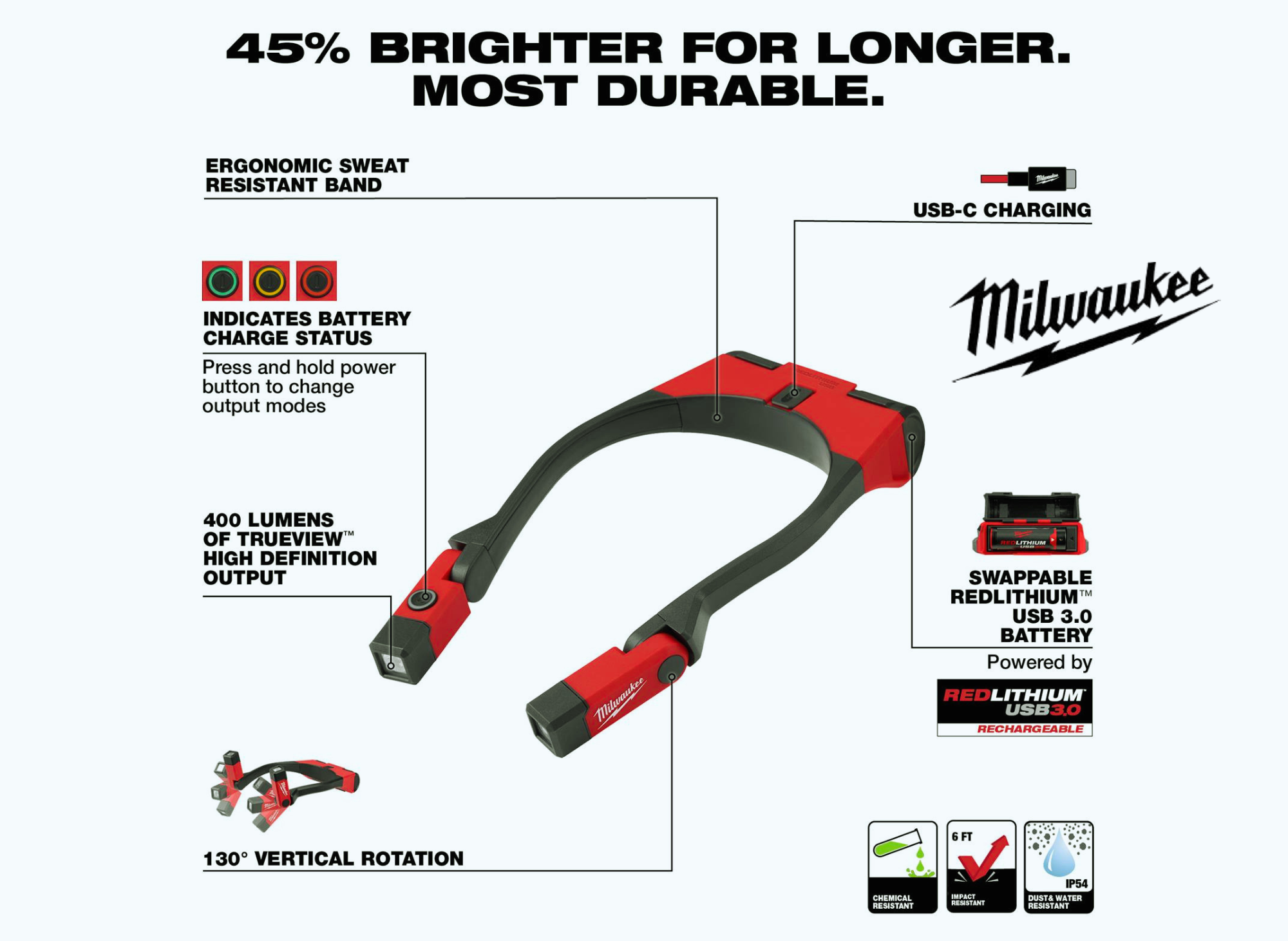
- Delivers 400 lumens on High and 250 lumens on Low, powered by TRUEVIEW high-definition output LEDs for accurate color rendering.
- Runs on a Milwaukee RedLithium USB ecosystem battery - specifically a RedLithium USB 3.0 battery included in the kit - with over 8 hours of battery life on the Low setting.
- Two light heads pivot up to 130° of vertical rotation, giving you complete light head adjustability without any headband or strap pressure.
- Rated IP54 for dust and water resistance, with a 6-foot drop rating and chemical resistance for shop environments.
This article walks through real-world performance, comfort, durability, pricing, and buying tips so you can determine whether this rechargeable neck light is a big deal for your workflow or just another premium-branded accessory.
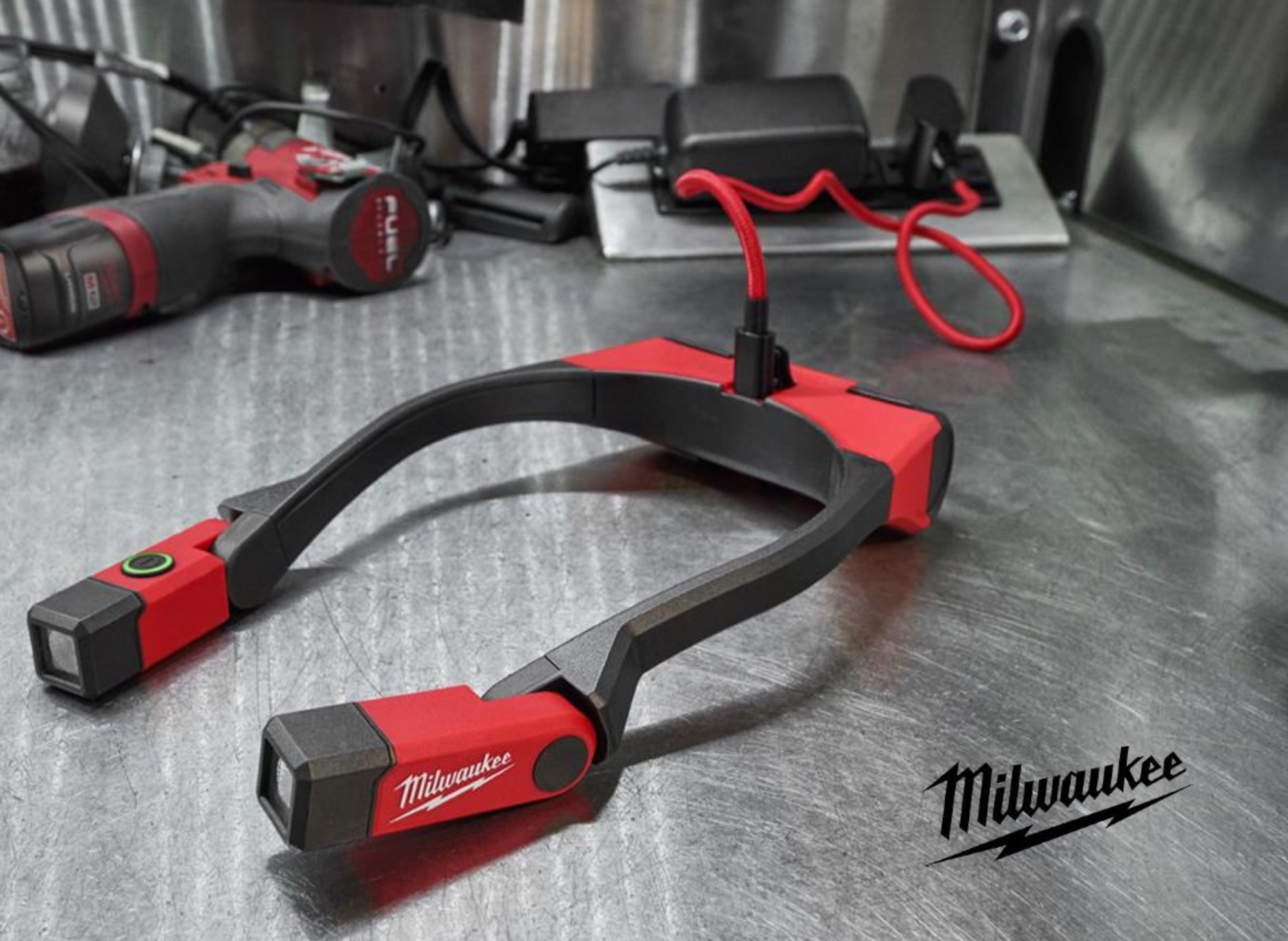
Milwaukee REDLITHIUM USB 400 Lumen Neck Lights 2117-21
Flashlights, REDLITHIUM USB 400L, Neck Light, LED, 2 Modes, 400 Lumens, Plastic, Black/Red, Rechargeable, Lithium-Ion, Each. Light up your tasks with this handy Milwaukee work light.
Key Features & Specifications of the Milwaukee 400 Lumen Neck Light
Here is a spec-level breakdown of the Milwaukee 2117-21, part of Milwaukee's REDLITHIUM USB personal lighting lineup:
- The Milwaukee REDLITHIUM USB 400L Neck Light provides 400 lumens of output on High mode with approximately 2.5 hours of run time, and 250 lumens on Low mode with more runtime - over 8 hours on a single charge—the light features two brightness settings that let you manage output based on the task at hand.
- TRUEVIEW LEDs deliver high-definition output with neutral color temperature, making it easier to distinguish wire insulation colors, fluid tints, and fastener markings compared to harsh blue-tinged LEDs found in cheaper lights.
- The neck light has dual independently adjustable light heads, each offering approximately 130° of vertical light head rotation. This vertical rotation provides easy positioning of flood-style task lighting rather than a narrow spot beam, which is ideal for close-up work in engine bays, panels, and tight mechanical rooms.
- Power comes from an included redlithium usb 3.0 battery that charges via usb c in approximately 2 hours. The power button includes a battery gauge to monitor remaining charge. The battery is a removable battery, compatible with other USB-powered lights in Milwaukee's REDLITHIUM USB family.
- Durability specs include an IP54 ingress protection rating (dust and water splash resistance from any direction), a 6-foot drop rating onto hard surfaces, and resistance to most chemicals and sweat found in auto shops and field conditions.
- The neck band uses a semi-rigid, flexible collar design with an ergonomic, sweat-resistant band. Total weight sits at approximately 0.5 lb including the battery, and the overall dimensions are roughly 8.9 × 5.2 × 1.5 inches - compact enough to wear over jackets, vests, and collared shirts without bulk.
Hands-Free Lighting: How the Milwaukee Neck Light Works on the Job
The Milwaukee neck light sits around the back of the neck and rests on your shoulders and collarbone. Unlike a headlamp, nothing presses against your forehead, and it doesn't interfere with hard hats, ball caps, or safety helmets. Milwaukee's neck light allows for maneuverability in tight spaces without head movement - the light stays aimed at your work surface regardless of where you turn your head.
Hands-free lighting is ideal for tasks like automotive repair and electrical work. Under-hood engine inspections, brake jobs, HVAC service calls in dark basements, and wiring diagnostics inside electrical panels all demand two free hands. With this neck light, there is no need to prop a flashlight on a fender, clamp an inspection light to a bracket, or stick one between your teeth.
The neck light can illuminate areas without obstructing physical movements, and the dual pods let you angle one beam directly at a work surface while pointing the other slightly ahead for peripheral visibility across a bay or job site. The neck light is useful in tasks that require a consistent forward-facing light, and easy positioning of each pod means quick adjustments between tasks.
That said, the design has honest limitations. The neck light is not suitable for lying on your back - gravity shifts the beam upward or into your chest, making a headlamp or magnetic inspection light a better choice for under-vehicle work in a supine position. In very tight crawl spaces where shoulders are compressed, the pods may hit surfaces or lose their angle. For overhead work where your head tilts back frequently, a strap-mounted headlamp may hold its aim more naturally.
The sweet spot is standing at a fender, kneeling at a cabinet, walking a job site, or working at a bench - any position where the light is 1 to 3 feet from your work surface, a nd your torso stays relatively upright.
Brightness, Beam Quality & Runtime Performance
The TRUEVIEW high-definition output on the Milwaukee 400 delivers neutral, color-accurate light. This matters more than most people expect. When you're tracing a wiring harness and need to tell a red wire from an orange one, or when you're checking coolant color in a reservoir, color rendering quality can affect your diagnostic accuracy. Harsh, blue-tinted LEDs wash out those distinctions; TRUEVIEW does not.
At 400 lumens, the High setting is plenty bright for engine bays, wheel wells, utility closets, and breaker panels at typical working distances. It fills a work area with broad flood light rather than a tight spot, which reduces sharp shadows around hoses, brackets, and wiring looms. The Milwaukee REDLITHIUM USB 400L Neck Light is well-suited for close-up work where you need even coverage, not a pencil beam.
The practical difference between High and Low comes down to intensity versus endurance. High mode (400 lumens, ~2.5 hours runtime) works best for short, intensive inspections or outdoor tasks after dark. Low mode (250 lumens, over 8 hours) gives you more runtime to cover a full shift of diagnostic or repair work without worrying about a dead battery mid-task. On Low, you still get enough output for indoor repairs and maintenance work - it is not dim by any standard.
Compared to generic neck lights in the 200–300 lumen range, this light is roughly 45% brighter. It is competitive with midrange headlamps and brighter than most pocket lights in the same price class. The housing manages heat dissipation well enough that extended High-mode use produces a slight warmth on the pods near the neck but nothing uncomfortable. You will notice warmth, not heat.

Comfort, Fit & Ergonomics Around the Neck
The neck band uses a semi-rigid collar that drapes across the shoulders and collarbone rather than gripping the head. This geometry eliminates the forehead pressure that makes headlamps uncomfortable over long periods. Neck lights minimize forehead pressure compared to traditional headlamps, and multiple users report the Milwaukee neck light is surprisingly comfortable to wear - many forget they have it on once they start working.
The balanced weight distribution places the battery pack at the rear and light pods at the front, keeping the collar stable during walking, bending, and reaching. At roughly half a pound, the weight is barely noticeable over a hooded sweatshirt or work jacket.
The neck light design accommodates safety gear without discomfort. It sits comfortably over light jackets, hoodies, high-vis vests, and collared shirts. Wearing safety glasses, hearing protection, or a respirator is unaffected because nothing is strapped to your head. The sweat-resistant band and chemical-resistant collar materials offer increased (comfort resistance) against shop irritants, perspiration in hot engine bays, and summer job site conditions.
From a safety standpoint, the low-profile collar reduces the risk of snagging on open hoods, cabinet edges, or overhead components. The pods are angled rather than bulky, which helps in moderately confined spaces. In very tight quarters, though, you should still be cautious - any wearable light adds a potential contact point.
Durability, Weather Resistance & Shop Survival
The IP54 rating means this Milwaukee neck light handles dust and water impact from any direction. In plain language, it will survive light rain, splashes from under a vehicle, and the general airborne grit of a construction site. It is water impact rated for splashing but not submersion - don't drop it in a bucket of coolant and expect it to shrug that off.
The 6-foot drop rating covers the real-world drops that happen daily: sliding off a fender, falling from a workbench, or tumbling out of a tool bag onto a concrete shop floor. Users report the light surviving these kinds of impacts with cosmetic scuffs but no loss of function.
Chemical resistance is where this light separates itself from budget alternatives. The housing and lenses resist most chemicals and harsh chemicals found in auto shops - oils, brake cleaner mist, coolant, and general shop solvents. The lenses don't cloud quickly, and the housing doesn't degrade from incidental exposure to harsh chemicals that would ruin cheaper plastics. This chemical resistance matters if you work in environments where fluid spray is inevitable.
The pivot joints on each light pod maintain their tension through dozens of adjustments per shift. No reports of joints going floppy after several months of daily use. Contrast this with cheaper neck lights that often have unsealed USB ports, flimsy bands, or low-grade plastics that crack in cold weather. The Milwaukee is built durable enough to be tossed into a tool bag alongside wrenches, bumped by creeper rails, and exposed to the general chaos of a working shop without quitting on you.
Battery System: Milwaukee REDLITHIUM USB Power & Charging
The included REDLITHIUM USB 3.0 battery is a compact, swappable, and removable battery that forms part of Milwaukee's broader REDLITHIUM USB ecosystem. If you already own other MilwaukeeUSB-poweredd lights or personal lighting tools, you likely already have compatible spare batteries and chargers on hand.
Charging happens through a usb c port built into the light. You can charge via a wall adapter, vehicle USB outlet, or portable power bank - whatever is closest. The light charges in 2 hours via USB-C to a full battery, and the battery gauge on the power button gives you a visual read on how much power remains so you are never caught off guard mid-task.
The benefits over disposable AA or AAA batteries are straightforward: consistent power delivery even at low temperatures, lower long-term cost, and no time wasted searching for replacement cells. A single full charge on Low mode comfortably covers a standard evening repair session or an entire service call route. On High, you get approximately 2.5 hours - enough for a focused inspection window before you recharge.
For professionals working long shifts or emergency response scenarios, spare REDLITHIUM USB batteries can be carried in a pocket and swapped in seconds. This makes the neck light viable for extended use without returning to a charging station. The power source is a removable rechargeable REDLITHIUM USB battery, so you are never tethered to a cord while working.
Compared to non-rechargeable neck lights that burn through alkaline batteries, the USB-C recharge cycle saves money over time and eliminates the hassle of tracking battery inventory. Plug it in at the end of the day, and it is ready for tomorrow.
Real-World Use Cases: Automotive, Trades & Outdoor Tasks
Automotive: Mechanics use the Milwaukee neck light for inspecting serpentine belts, tracing fluid leaks, performing brake work, and running interior diagnostics. When your right hand holds a scan tool, and your left hand holds a test lead, there is no third hand for a flashlight. The dual pods illuminate both sides of an engine bay simultaneously, and the flood beam covers complex assemblies without harsh shadows.
Electrical and HVAC: Electricians working inside breaker panels, junction boxes, or furnace compartments need their hands for meter leads and tools. The neck light keeps a consistent beam on wire terminations and labels, and the TRUEVIEW output helps identify conductor colors accurately - something that can directly affect safety and code compliance. HVAC techs servicing rooftop units after dark get broad work-area illumination without a headlamp bouncing around.
Plumbing and Facility Maintenance: Under-sink spaces, boiler rooms, valve stations, and mechanical rooms are rarely well lit. Neck-level lighting puts the beam right where your hands are working, and you can adjust each pod independently to cover gauges, fittings, or pipe runs.
Construction and Carpentry: Framing punch lists, drywall inspections, and finish work in new builds often happen before permanent lighting is installed. The neck light fills in for missing overhead fixtures and helps spot surface defects, nail placement issues, and alignment problems in dim conditions.
Outdoor and Home Use: Campsite setup, evening yard work, emergency storm repairs, and power outages all benefit from wearable, hands-free lighting. The neck light works great for any outdoor scenario where carrying a flashlight would leave you one hand short of what the task demands.
For maximum coverage, consider pairing the neck light with other Milwaukee area lights or inspection lights. Layered lighting - neck light for close task work, area light for general illumination - reduces shadows and improves safety in a garage bay or equipment room.

Milwaukee Neck Light vs Other Neck Lights & Headlamps
The core form-factor advantage of a neck light over a headlamp is simple: nothing on your head. If you wear a hard hat, ball cap, or safety helmet, strapping a headlamp over or under that gear adds bulk, pressure, and fiddling. The Milwaukee neck light eliminates that entirely. Customers who have tried both consistently prefer the neck format for comfort during extended wear.
On brightness, the Milwaukee 400 lumen output is substantially brighter than typical generic neck lights in the 200–300 lumen range. It produces less total output than heavy-duty flashlights, but it is practical for two-handed tasks where a flashlight would need to be set down anyway. Midrange headlamps compete on raw lumens, but few offer the same broad flood coverage from a neck-worn platform.
Comfort is where neck lights pull ahead for long periods of upright work. No forehead strap means no headaches, no sweat-soaked elastic, and no readjusting every ten minutes. However, a headlamp may stay aimed more consistently when working overhead or lying down - situations where gravity works against a neck-mounted light.
Durability separates the Milwaukee from budget competitors. Its IP54 rating, 6-foot drop rating, and resistance to dust and water put it in a different class than generic neck lights with untested or IPX4-level ratings, unsealed ports, and hinges that loosen after a few weeks. Many low-cost neck lights also rely on disposable batteries, which increases long-term operating cost and inconvenience.
On price, the Milwaukee sits higher than budget neck lights. But the extra cost goes toward brighter LEDs, a rugged housing, a pro-grade rechargeable battery system, and a manufacturer warranty - features that customers who use the light daily will appreciate far more than occasional users.
Price, Value & Finding a Lower Price on the Milwaukee 400
The Milwaukee neck light retails for $99.99 as a kit that includes a RedLithium USB 3.0 battery and USB-C charging cable. It is available at various Milwaukee retailers, including major home improvement stores and online tool suppliers. Amazon has competitive pricing for the Milwaukee neck light, and other sellers may offer lower prices depending on promotions and region.
When evaluating value over time, consider that the rechargeable design eliminates ongoing battery purchase costs. If you use a neck light several times a week, the money saved on disposable batteries adds up within months. The durable construction and long LED lifespan also mean you are unlikely to need a replacement any time soon.
To find a lower price, watch for seasonal Milwaukee tool promotions, holiday sales events, and bundle deals where the neck light is packaged with other REDLITHIUM USB accessories. Some retailers provide a same-page link to current promotions or allow customers to report finding a lower price elsewhere, though price matching policies vary by store and not every reported price can be matched. Availability and delivery timelines may also differ between online and in-store channels.
When comparing prices across sellers, look at the complete package contents - battery, cable, and warranty - rather than just the sticker price. A bare-tool listing without the battery dramatically changes the actual value. Factor in the return policy, warranty coverage, and shipping cost before making a purchase, not simply the lowest number you find in a quick search.
Warranty, Support & Return Considerations
Milwaukee backs this neck light with a limited lifetime warranty on the LED and housing. The REDLITHIUM USB battery typically falls under a separate warranty term, so verify the exact coverage at the time of your purchase. The manufacturer provides clear documentation on what is and is not covered.
Manufacturing defects - early LED failure, housing seal leaks, electronic malfunctions - are generally covered. Damage from abuse, unauthorized modifications, or exposure beyond the rated specs (for example, full submersion or repeated drops from well above 6 feet) is excluded. You have every legal right to file a warranty claim for legitimate defects, so keep your proof of purchase and register the product where applicable.
Most retailers offer a return window - often around 30 to 90 days - that gives you time to test fit, comfort, and performance. Check the specific return policy at your store before buying, and for wearable equipment like neck lights, testing how it feels over a full shift matters.
Buying from authorized dealers ensures genuine Milwaukee components, valid warranty coverage, and smoother service if something goes wrong. Grey-market or unauthorized listings may come with mismatched batteries or no warranty support at all.
Buying Tips: How to Choose the Right Milwaukee Neck Light Setup
Start by considering how often you work in the dark or in low light. If it is a daily occurrence, pick up a spare REDLITHIUM USB battery alongside the neck light so you always have a charged pack ready. For occasional use, the included battery is sufficient.
Evaluate your typical work positions. If you spend most of your time standing, kneeling, or at a bench, the neck light alone may cover your needs. If you regularly work overhead or in a supine position, consider pairing it with a compact headlamp or magnetic inspection light to fill the gaps.
Check compatibility with any existing Milwaukee REDLITHIUM USB tools you own. Shared batteries and chargers reduce the incremental cost of adding this light to your kit.
If you expect to wear the light for most of a shift - especially over jackets or safety gear - pay attention to the weight and comfort specs. At half a pound, most users find it barely noticeable, but testing it with your full PPE loadout is worth doing within the return window.
Professionals who move between indoor and outdoor tasks will get the most from the 400-lumen High mode. If your work is entirely indoors at close range, a smaller light might suffice - but the expected performance gap between 150-lumen budget options and this Milwaukee is substantial enough to notice immediately.
Care, Maintenance & Safety Best Practices
After each use in dusty or greasy conditions, wipe down the neckband and light pods with a damp cloth. Avoid solvents not approved for plastics; the housing resists chemicals found in typical shop environments, but aggressive industrial degreasers can still affect rubber seals over time. Clean the lenses regularly to maintain full light output.
Use quality usb c chargers and avoid charging in standing water or extreme heat. Inspect the charging cable and port periodically for debris or damage - a clogged port can slow charging or prevent a solid connection. The light charges efficiently from any standard USB-C source, so a dedicated adapter is not strictly necessary.
For battery care, avoid leaving the REDLITHIUM USB pack fully drained for extended periods. Store it in a cool, dry place between uses, ideally at a partial charge if you will not use it for weeks. Do not crush or puncture the pack.
Safety reminders: do not stare directly into the LEDs at close range, and be mindful of coworkers nearby. In cramped spaces, the beam can blast into someone else's eyes if pods are angled outward. Adjust pod angles consciously when working alongside others.
Store the neck light in a dedicated compartment in your tool bag or case. Keeping it separated from heavy tools prevents accidental bending or crushing of the collar and pods.
Customer Feedback & Common Questions About the Milwaukee Neck Light
Across review platforms and trade forums, several feedback themes stick out consistently. Users praise the brightness for its size - 400 lumens in a wearable form factor is noticeably brighter than what most people expected from a neck-worn light. The comfortable, hands-free operation is another recurring highlight. Many customers note that the rechargeable REDLITHIUM USB system is far more convenient than swapping disposable batteries every few shifts.
Common concerns center on the price relative to basic neck lights and whether the output justifies the cost. For daily professional use, most reviewers conclude it does. Performance when lying down is another frequent question - the consensus is that this light does not replace a headlamp for supine work. Some users also ask whether the light feels secure during fast movement or leaning over; the general answer is that it stays put during normal work motion but can shift during aggressive bending or twisting.
Runtime questions come up often. In everyday use, High mode reliably delivers around 2.5 hours and Low mode exceeds 8 hours, matching Milwaukee's claims. Brightness diminishes gradually as the battery depletes rather than cutting out suddenly, which is helpful for finishing a task before swapping the pack.
On durability, users in professional shop and job site environments report the neck light surviving drops, oil exposure, and daily wear without mechanical failure. Cosmetic scratches appear, but optical and electronic performance holds up. If you are looking for a thorough review of how this light performs in your specific trade, checking recent ratings from customers in similar conditions is the best way to calibrate expectations.

Conclusion: Is the Milwaukee 400 Lumen Rechargeable Neck Light Worth It?
The Milwaukee 2117-21 brings together 400-lumen TRUEVIEW output, a rechargeable REDLITHIUM USB battery, hands-free neck-worn design, IP54 dust and water protection, and a 6-foot drop rating - all built for professional and serious DIY use. It is not a novelty; it is a purpose-built piece of equipment for people who need both hands and reliable light simultaneously.
Ideal users include automotive techs, electricians, HVAC professionals, facility maintenance staff, and home users who frequently work in dim spaces. If you are tired of juggling a flashlight or dealing with a headlamp that slips, this neck light solves real problems.
The price is higher than generic alternatives, but the brighter output, proven rechargeable platform, durable construction, and manufacturer-backed warranty make the total value proposition stronger than the sticker number suggests.
Factor in runtime, comfort, and long-term battery savings when you decide whether the Milwaukee 400 lumen rechargeable neck light is the right hands-free solution for your work. If the point of a work light is to disappear into the background while you focus on the job, this one delivers.
Thank you for reading!
Your friend,
Todd
#Milwaukee 🔴🛠️ #MilwaukeeTool 💪🔧 #NeckLight 💡👔 #HandsFreeLight 🙌🔦 #WorkLight 🏗️✨ #ProTools ⚙️🥇 #WorkSmarter 🧠💡 #TradeLife 👷♂️🔩 #DIYReady 🔨🎯 #GearThatGlows 🌟🔦
This site contains affiliate links, and we may earn a commission at no extra cost to you. All recommended products are thoroughly vetted.
 Todd Bandel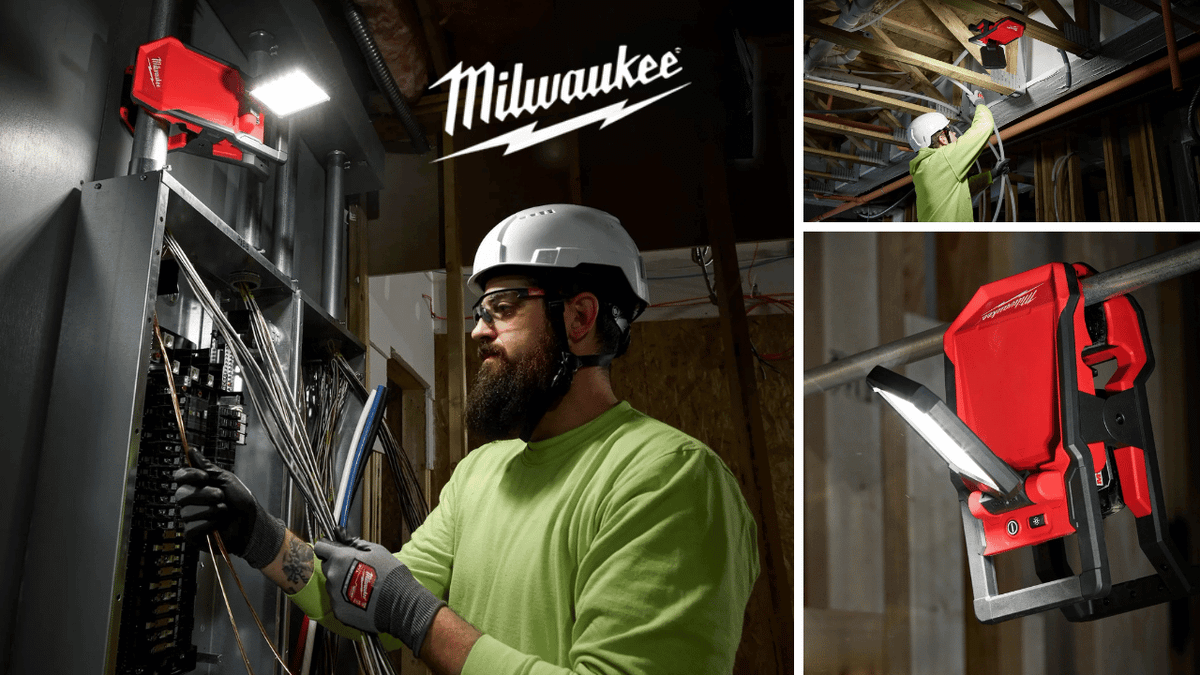
 Todd Bandel
 Todd Bandel
 Todd Bandel
 Todd Bandel