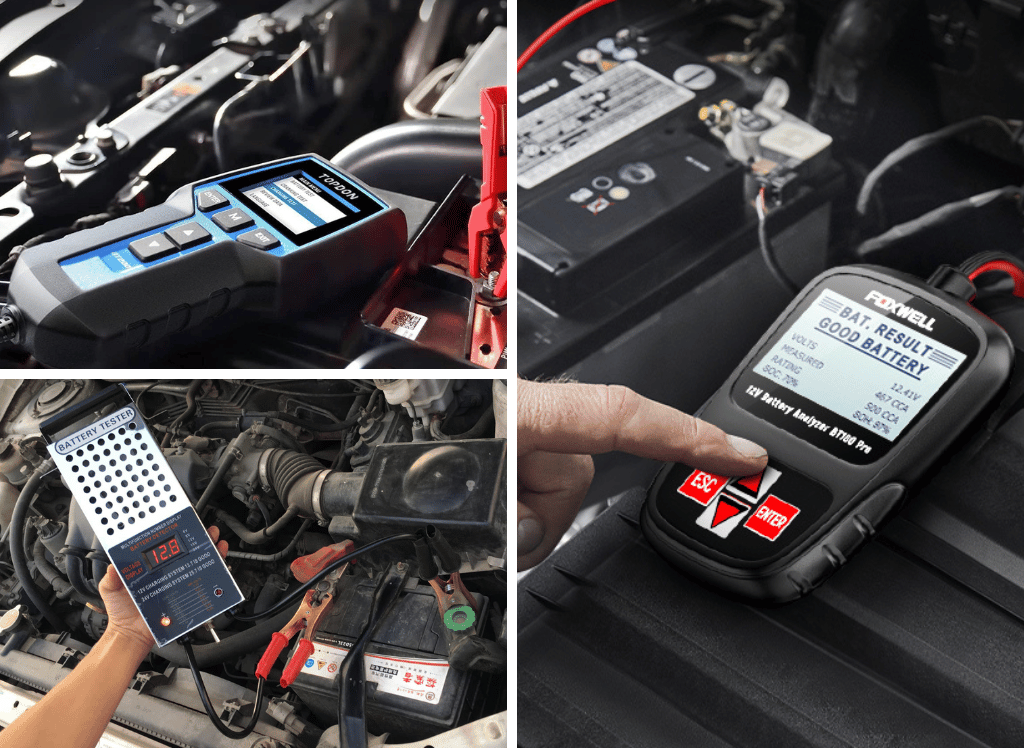
VDIAGTOOL BT500: The 6V/12V/24V Automotive Battery Tester
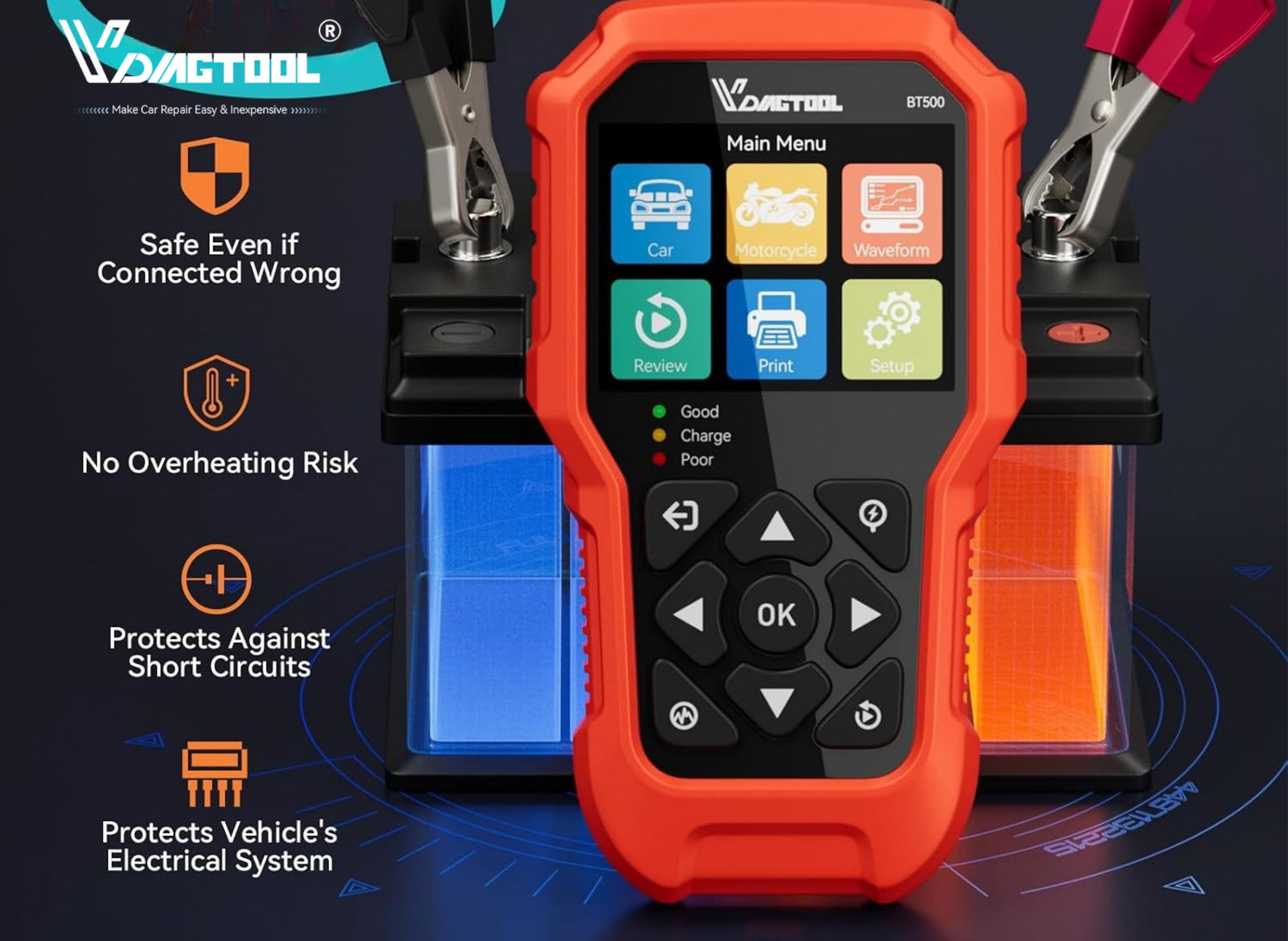
It accurately tests 6V, 12V, and 24V batteries, supporting regular flooded, AGM flat plate, AGM spiral, GEL, and EFB batteries.

A dead battery never picks a convenient time to fail. The VDIAGTOOL BT500 is designed to help you catch problems before they leave you stranded. Here is everything you need to know about this handheld battery tester, from specs and test procedures to real-world use cases and buying considerations.
Overview of the VDIAGTOOL BT500 Car Battery Tester
The VDIAGTOOL BT500 is a handheld car battery tester and system analyzer built for 6V, 12V, and 24V lead-acid batteries found in cars, trucks, SUVs, motorcycles, boats, and small equipment. It is a dedicated automotive battery and charging system analyzer that covers a wide 5 3000 CCA range, making it capable of testing everything from a small motorcycle battery to a heavy-duty truck battery.
What sets it apart from a simple voltage check is that the BT500 combines a battery health assessment, a cranking test for evaluating starter performance, and an alternator tester function for verifying the vehicle's charging system, all in one compact tool. It effectively serves as a battery load tester alternative for DIYers, fleet operators, and professional mechanics who need fast, reliable diagnostics without hauling around heavy equipment.
The VDIAGTOOL BT500 is listed on Amazon (ASIN B0DBLKZ3XF) and typically carries a 4.4-star average from hundreds of ratings. The VDIAGTOOL BT500 costs $44.99 at Walmart, and the VDIAGTOOL BT500 is available on eBay as well, giving buyers several purchasing options. The VDIAGTOOL BT500 has a 4.8 out of 5 rating from satisfied users, and the product is praised for its multiple features at a good price point.
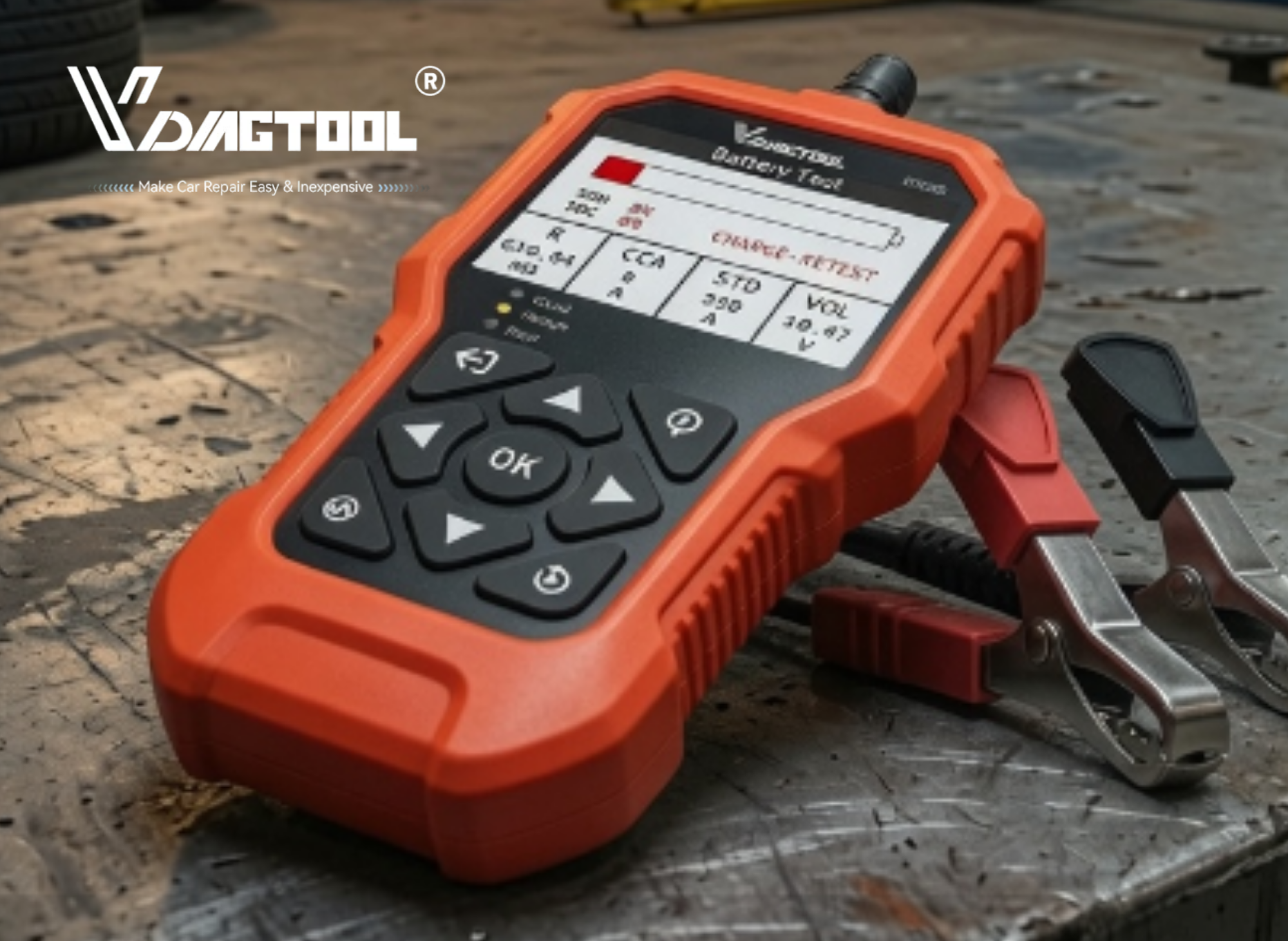
VDIAGTOOL BT500 Car Battery Tester
5-3000 CCA Battery Load Tester, Starter Alternator Tester Automotive Charging Cranking System Analyzer for Car Truck Motorcycle SUV ATV Boat
Key Features at a Glance
Here is what the BT500 brings to the table:
- Voltage range: Tests 6V, 12V, and 24V battery systems, covering passenger vehicles, commercial trucks, classic cars, and powersport equipment.
- CCA coverage: Supports battery load testing from 5 to 3000 CCA, one of the widest ranges in its price class.
- Supported battery chemistries: Compatible with regular flooded, AGM flat plate, AGM spiral (e.g., Optima-style), gel, and EFB batteries. Not compatible with lithium batteries, deep-cycle house batteries, or golf-cart packs.
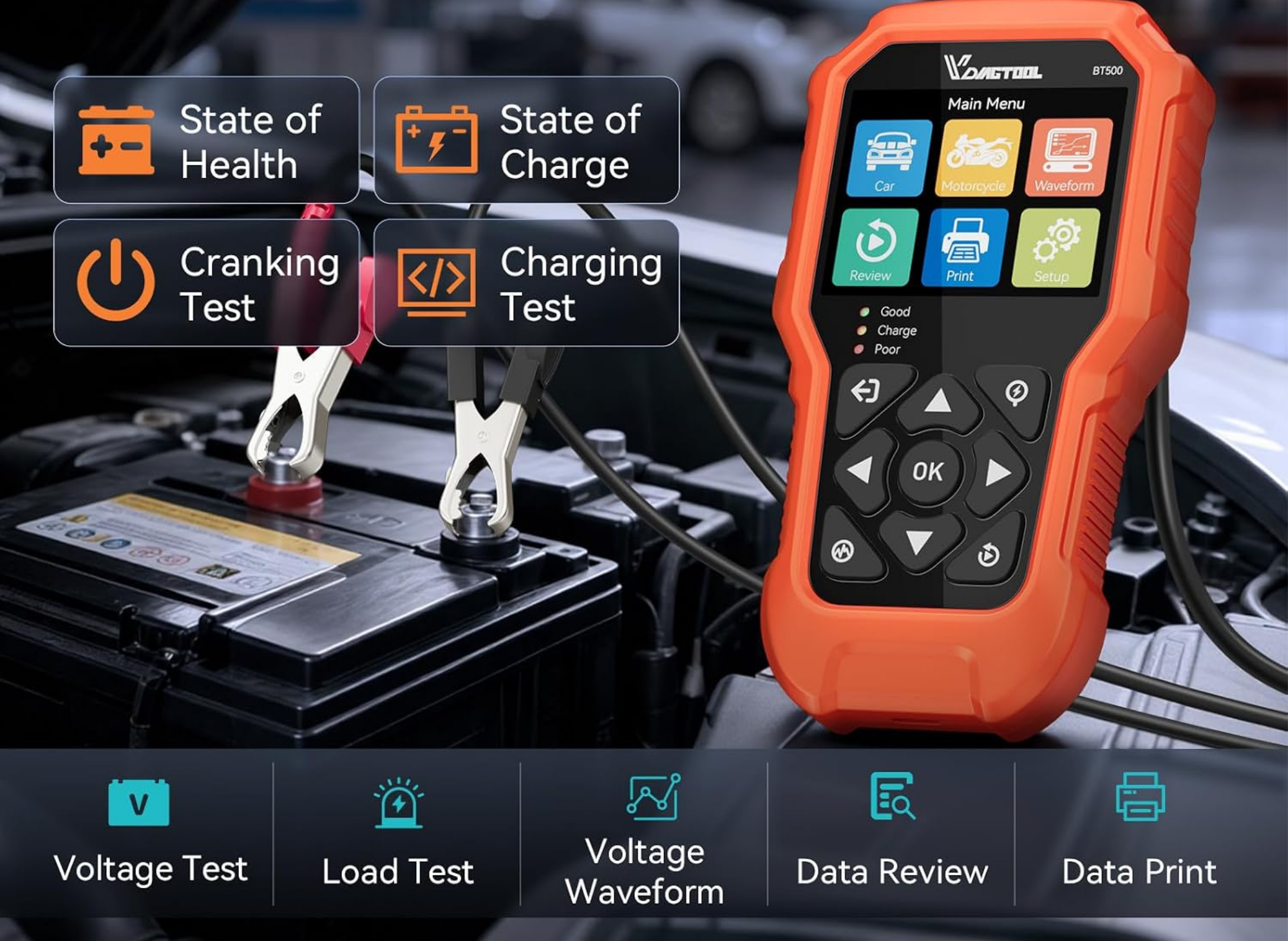
- Diagnostic metrics: Real-time display of voltage, internal resistance, state of health soh, state of charge soc, and measured cold cranking amps cca compared to the rated value.
- System tests: Built-in cranking test (starter) and charging test (alternator) functions to evaluate the entire starting and charging system, not just the battery itself.
- Data and connectivity: Internal data storage for past test results, PC connection via usb cable for downloading and printing reports, and lifetime free firmware updates.
- Accuracy: Advertised up to 99.99% accuracy powered by an intelligent chip and conductance-based measurement algorithm.
- Safety: The BT500 includes safety features such as reverse polarity protection, overvoltage protection, short-circuit prevention, and spark-suppression clamp design.
- Wide compatibility: The tester can be used on various vehicle types including cars, trucks, and boats, supporting regular flooded agm flat plate, agm spiral gel, and EFB types.
Understanding Battery Testing and Battery Health
Modern vehicles demand more from their batteries than ever before. Between electronic systems like infotainment screens, advanced driver-assist modules, and stop-start functionality, the electrical load on a car battery is significant. A battery that tests fine with a simple voltmeter may still fail under the stress of cranking a cold engine.
Battery health, in practical terms, means the battery's ability to deliver its rated cold cranking amps, maintain stable voltage under load, and recover quickly after starting the engine. When any of these degrade, you are one cold morning away from a no-start situation.
The BT500 measures voltage, internal resistance, and Cold Cranking Amps (CCA) to give a comprehensive analysis of battery condition. It also reports state of health (percentage of original capacity remaining) and charge status (how much energy is currently stored). By comparing measured CCA against the rated value printed on the battery label, you get a clear picture of whether the battery still has adequate power.
Several factors accelerate battery aging:
- Repeated short trips that never allow a full charge cycle
- Extreme temperature swings (both heat and cold)
- Long periods of storage without a maintenance charger
- Parasitic drains from aftermarket accessories
A dedicated automotive battery tester like the BT500 is far more precise than checking voltage alone or trusting a dashboard indicator. It tests battery health and charging systems effectively, catching a weak battery or a failing battery before it causes unexpected breakdowns. Timely detection also reduces stress on the alternator, which can wear out prematurely when compensating for a degraded battery.
Battery Compatibility: 6V, 12V, 24V and Supported Battery Types
The VDIAGTOOL BT500 is engineered specifically for 6V, 12V, 24V battery systems using lead-acid chemistry. This covers the vast majority of automotive and light commercial applications.
Typical 6V uses:
- Classic and vintage cars (pre-1950s models)
- Some motorcycles and scooters
- Lawn and garden equipment
- Older tractors and utility vehicles
Typical 12V uses:
- Most passenger cars, SUVs, and pickups
- Motorcycles, ATVs, and snowmobiles
- Small boats, personal watercraft, and generators
- Standby power systems
Typical 24V uses:
- Medium and heavy trucks (semi-trucks, delivery vehicles)
- Some RVs and buses
- Construction and agricultural machinery
- Marine systems using 24V battery banks
The BT500 supports the following battery chemistries: standard flooded lead acid (wet cell), flooded AGM flat plate, AGM spiral wound, gel, and EFB batteries used in modern stop-start equipped vehicles. Users should select the correct battery type from the on-screen menu before running any test, as the conductance algorithm adjusts its calculations based on chemistry.
It is important to note that the BT500 is not intended for lithium batteries (lithium-ion or LiFePO4), deep-cycle house bank batteries commonly found in solar or RV setups, or golf-cart battery packs. Using the tester on unsupported chemistries may produce misleading results. If you work with those battery types, look for a tool specifically designed for that chemistry.
Always confirm the battery type and rated CCA (or equivalent standard) printed on the battery label before testing. Entering incorrect parameters will skew the test results.
Battery Standards and the 5–3000 CCA Measurement Range
Cold cranking amps is the primary metric the BT500 uses for evaluating starting batteries. CCA measures how many amps a battery can deliver at 0°F (−18°C) for 30 seconds while maintaining a minimum voltage threshold. It is the single most important number for cold-weather starting reliability.
The BT500 accepts rated values from 5 to 3000 CCA, an unusually wide range for a tester in this price bracket. That means it can handle a tiny 20 CCA powersport battery just as easily as a massive 2,500 CCA truck battery.
The tool supports most car battery standards, including:
These are simply different car battery standards defining the conditions under which the battery is rated. Before running a battery test, the user selects the appropriate standard and enters the rated value from the battery label. If your battery is labeled in EN or DIN rather than CCA (common in Europe), the BT500 can interpret those correctly.
This wide compatibility makes the BT500 a practical choice for mixed fleets and multi-vehicle households where you may be testing anything from a motorcycle to a construction excavator.
In‑Vehicle vs Out‑of‑Vehicle Battery Test Procedures
The BT500 supports two battery test approaches, each suited to different situations.
In‑Vehicle Testing
This is the fastest method for routine checks. The battery stays in the vehicle, connected to the car's wiring:
- Turn the ignition off and shut down all accessories.
- Connect the red clamp to the positive terminal and the black clamp to the negative terminal.
- Select "Battery Test" from the menu.
- Enter the battery type (regular flooded, AGM, GEL, or EFB) and the rated CCA or equivalent standard value.
- Run the test.
In-vehicle results account for the vehicle's wiring and any parasitic loads. This is useful for a quick health check, but keep in mind that corroded terminals or high-resistance wiring can slightly affect readings.
Out‑of‑Vehicle Testing
For a more controlled measurement, disconnect and remove the battery:
- Disconnect negative cable first, then positive.
- Clean the terminals if needed.
- Connect BT500 clamps directly to the battery posts.
- Run the same battery test procedure.
Out-of-vehicle testing isolates the battery from any vehicle wiring resistance or parasitic draws. This is the better approach for diagnosing borderline batteries, confirming a "Recharge & Retest" result, or evaluating a battery before installation.
In both modes, the BT500 displays voltage, state of health, state of charge, internal resistance, and measured CCA. Its display shows results in a clear and understandable format, often accompanied by a verdict like "Good," "Recharge," or "Replace."
Safety basics: Always connect red to positive and black to negative. Keep the engine off and ignition off during battery tests. Avoid loose clothing and jewelry near the engine bay.
Using BT500 as a Starter (Cranking) and Alternator Tester
Beyond a standalone battery test, the VDIAGTOOL BT500 functions as a starter tester and alternator tester, allowing you to diagnose the entire starting and charging system from a single tool.
Cranking Test
The device performs cranking tests to evaluate starter performance:
- Connect the BT500 to the battery with the engine off.
- Select "Cranking Test" from the menu.
- Follow the on-screen prompt to start the engine.
- The tester records the minimum voltage during cranking and how quickly voltage recovers.
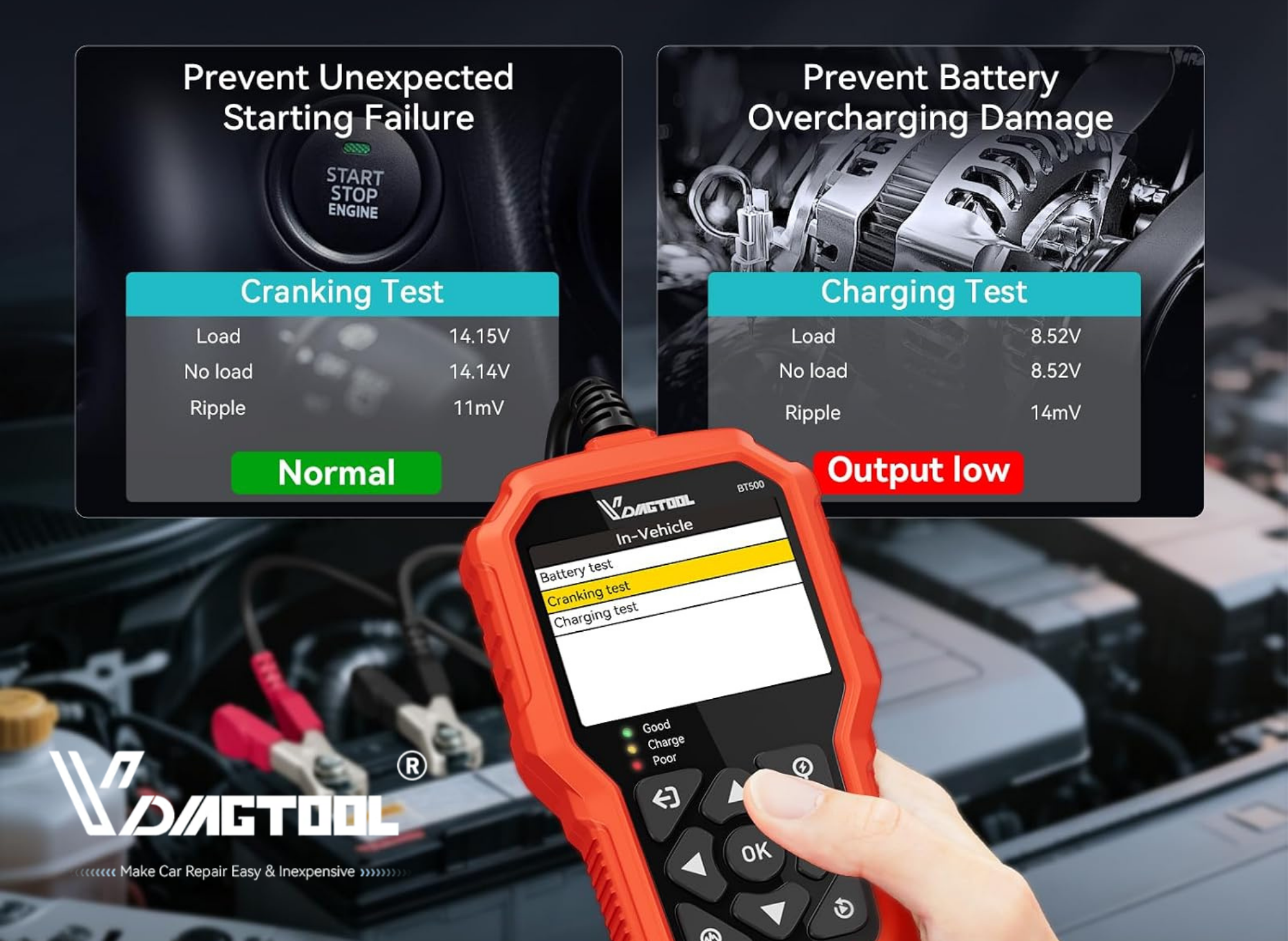
If cranking voltage drops too low (typically below ~9.6V for a 12V system), the tester flags a problem. The root cause could be a weak battery with high internal resistance, a failing battery that can no longer deliver adequate current, or a starter motor drawing excessive amperage due to mechanical wear.
Charging Test
The BT500 also runs charging system tests to verify alternator output:
- With the engine running at idle, select "Charging Test."
- The tester measures the vehicle's charging system voltage and checks for ripple or instability.
- Turn on electrical loads (headlights, blower, rear defogger) when prompted to test alternator output under demand.
For 12V systems, healthy alternator output typically falls between 13.5V and 14.8V. For 24V systems, expect roughly double. Readings below this range suggest a weak alternator or slipping belt. Readings above it indicate a faulty voltage regulator that could damage electronic systems and boil battery electrolyte.
Identifying electrical issues in the charging system early prevents the cycle of repeated battery failures and protects sensitive vehicle electronics.
Accuracy, Intelligent Chip, and Safety Protections
The BT500 uses a dedicated microprocessor and conductance-based measurement algorithm to deliver repeatable, accurate results. It provides fast and accurate diagnostics with up to 99.99% accuracy relative to reference instruments under controlled conditions.
How Conductance Testing Works
Unlike traditional carbon-pile load testers that apply a heavy discharge to the battery, conductance testing sends a small AC signal through the battery and measures the response. This estimates internal resistance and overall battery health without significantly discharging the battery. The result is a faster, safer test that will not damage an already weak battery.
Safety Protections
The BT500 is designed with multiple layers of protection:
- Reverse polarity protection: If you accidentally reverse the clamps, the tester and battery are protected from damage. This polarity protection feature is especially helpful for beginners.
- Overvoltage protection: Guards the tester's electronics against voltage spikes.
- Short-circuit protection: Prevents damage if clamps accidentally touch each other.
- Spark-suppression clamps: Copper alligator clips and thick cable leads minimize sparking and reduce contact resistance during testing.
The tester is powered directly by the battery being tested, so there are no internal batteries to charge or replace. However, this means the BT500 will not power on if the battery is completely dead-you will need to put some charge into it first with an external charger.
Even with these protections, standard safety practices apply: avoid touching bare metal clamp surfaces, keep cables clear of moving engine parts, and always follow the user manual.
Display, Controls, and Build Quality
The device features a 2.8-inch LCD display that provides easy-to-read results even in typical garage or outdoor lighting. Text and numbers are large enough to read at arm's length, and LED indicator lights (red, yellow, green) give an instant pass/fail snapshot.
Navigation is straightforward. Physical buttons (typically up, down, OK/Enter, and Back) let you move through menus for battery test, cranking test, charging test, and data review. There is no touchscreen, which actually works in the tester's favor-greasy fingers and touchscreens do not mix well in a workshop.
The unit measures approximately 6.45 × 3.35 × 0.96 inches and weighs around 15 ounces. That makes it compact enough to slip into a toolbox drawer, yet substantial enough to feel solid in hand. The housing is impact-resistant ABS plastic, and the clamps are made from pure copper for better conductivity.
The operating temperature range sits between roughly 0°C and 50°C (32–122°F), which suits typical garage environments. If you are testing in extreme cold or heat, allow the tester to acclimate to ambient temperature for a few minutes before running diagnostics, as temperature can influence measurement precision.
Data Storage, Review, and USB Printing
The BT500 can store multiple battery test sessions in internal memory, which is a feature you will appreciate if you maintain several vehicles or run a small shop.
Reviewing Stored Data
Access past results through the "Data Review" menu. Each stored session includes:
- Date and time of the test
- Battery type and rated standard entered
- Measured voltage, internal resistance, SOH, and SOC
- Pass/fail verdict ("Good," "Recharge," "Replace")
This allows you to track a battery's decline over months and make replacement decisions based on trend data rather than a single snapshot.
USB Connection and Printing
The BT500 allows data storage and printing via USB connection. Using the included usb cable, connect the tester to a Windows PC (Windows 10/11 compatible). Dedicated software lets you download, view, and print structured product details and test reports.
A printed report typically shows:
- Battery voltage and internal resistance
- State of health and state of charge
- Measured CCA vs. rated CCA
- Cranking and charging test results
- Any user or vehicle notes
For used-car dealers, these reports serve as documented proof of battery condition during a sale. For fleet managers, they create a maintenance paper trail. For shops, they justify warranty claims or upsell battery replacement when the data supports it.
VDIAGTOOL also offers lifetime free firmware updates via USB, so the tester's algorithms and compatibility stay current without additional cost.
Practical Use Cases: From Cars to Boats and Yard Equipment
The BT500 is versatile enough to cover a wide range of real-world scenarios. Here are some of the most common.
Pre-winter car check: Before the first freeze, test your car battery to confirm it still delivers adequate CCA and has a healthy state of charge. A battery rated at 700 CCA that measures only 400 CCA is a ticking clock once temperatures drop. Catching this in October is far cheaper than a tow bill in January.
Seasonal vehicles: Boat owners, motorcycle riders, and RV enthusiasts deal with long storage periods. Testing starter batteries and auxiliary 12V banks at the beginning and end of each season catches degradation early and prevents dockside or campsite failures. Marine batteries in particular benefit from regular monitoring since corrosive environments accelerate terminal wear.
Yard and garden equipment: Lawn tractors, zero-turn mowers, and standby generators rely on small 12V batteries that sit idle for months. A quick test at the start of mowing season saves the frustration of a no-start on the first warm weekend. One user mentioned it tests generators as well, confirming the BT500's usefulness beyond cars, trucks and motorcycles.
Small workshops and dealerships: Use the BT500 as a quick triage tool during vehicle intake. A two-minute battery test can determine whether a customer's complaint is battery-related or points to deeper electrical issues, saving diagnostic time.
Preventive maintenance routine: Testing every 3–6 months, or before any long trip, is a simple habit that prevents unexpected breakdowns and extends battery service life.
Interpreting Results and Deciding When to Replace a Car Battery
The BT500 gives you numbers and a recommendation, but understanding what those numbers mean helps you make smarter decisions.
SOH Thresholds
CCA Comparison
Compare the measured CCA to the rated CCA printed on your battery. If measured CCA drops below roughly 50% of rated, the battery is unlikely to start a cold engine reliably. A 12V battery rated at 700 CCA measuring only 350–400 CCA with elevated internal resistance is a strong candidate for replacement. One measuring 85–90% of its rated CCA is still serviceable.
Understanding the Verdicts
The BT500 typically displays messages like:
- Good: Battery is healthy; no action needed.
- Good – Recharge: Health is fine, but charge status is low. Charge the battery, and you are set.
- Recharge & Retest: State of charge is too low for a reliable health reading. Bring the battery to full charge and test again.
- Replace Battery: Health metrics indicate the battery has reached end of life.
A discharged but healthy battery (low SOC, normal internal resistance) looks very different from a worn-out battery (low SOH, high internal resistance). The first recovers after charging; the second will not. Always retest after bringing the battery to full charge when the tester suggests "Recharge & Retest."
Finally, consider age (most OEM car batteries last 3–6 years), climate, and usage patterns alongside BT500 readings before committing to a replacement. And check the charging system for under- or overvoltage before blaming the battery alone-a faulty alternator can kill a brand-new battery in weeks.
BT500 vs Traditional Battery Load Testers and Multimeters
If you have been around garages long enough, you have probably seen a carbon-pile battery load tester-a heavy box with a large analog needle gauge that applies a substantial load to the battery and measures the resulting voltage drop.
Here is how the BT500 compares:
A multimeter tells you voltage. A load tester tells you if the battery holds voltage under stress. The BT500 acts as a battery analyzer plus (tester) automotive tool, delivering voltage, internal resistance, CCA, SOH, SOC, cranking behavior, and charging system health in one review cycle. That is a comprehensive analysis from a single device.
For professional shops, the BT500 provides more repeatable and documentable results than subjective visual checks or single-reading methods. That said, it is not a replacement for full electrical system diagnostics when complex issues like CAN-bus faults or module-level communication errors are suspected. It handles the battery and charging side; deeper electrical issues require a scan tool.
Limitations, Best Practices, and Safety Tips
No tool is perfect. Here are the BT500's boundaries and how to work within them.
Limitations
- Not compatible with lithium batteries, deep-cycle house bank batteries, or golf-cart packs. Using it on unsupported chemistries risks inaccurate or misleading readings.
- Requires some minimal residual voltage to power on. A completely dead battery will need external charging before the BT500 can test it.
- Not designed for high-voltage EV or hybrid battery packs.
- Some users report inconsistent readings from the device, particularly when terminals are dirty, the battery is at extreme temperature, or the wrong battery type or CCA standard is selected.
Temperature Considerations
Batteries should ideally be near room temperature for the most accurate results. Extremely cold or hot conditions can temporarily skew internal resistance and CCA readings. If you must test in extreme weather, allow the battery and tester to acclimate for several minutes.
Best Practices
- Clean battery terminals before connecting clamps. Corrosion adds contact resistance and degrades accuracy.
- Always enter the correct battery type and rated CCA standard before testing.
- Fully charge a deeply discharged battery before performing a definitive health test.
- If a healthy battery keeps going flat, investigate parasitic drain from aftermarket accessories or faulty modules.
Safety Tips
- Wear eye protection when working near batteries. Lead-acid batteries can vent hydrogen gas, especially during and after charging.
- Avoid open flames or sparks near battery banks.
- Do not test batteries with swollen cases, cracked housings, or visible acid leaks. Replace them immediately regardless of what any tester might say.
- Keep loose clothing and metal jewelry away from battery terminals.
Who Should Buy the VDIAGTOOL BT500?
The Vdiagtool BT500 is designed for both DIY users and professional mechanics. But let's break down who gets the most value from it.
DIY car owners: If you maintain one or more vehicles, the BT500 pays for itself the first time it catches a failing battery before a tow truck does. Testing your own car battery and alternator at home takes minutes and costs nothing beyond the initial purchase.
Small garages and auto parts retailers: Use it as an intake triage tool. A quick battery test during every service visit builds customer trust and creates upsell opportunities when the data genuinely supports a replacement.
Used-car dealers: Generate printed battery health reports to show prospective buyers that the battery is in documented good condition. It adds credibility to the sale.
Fleet managers: Delivery vans, service vehicles, and construction equipment cannot afford downtime from unexpected battery failures. Scheduled quarterly testing with the BT500 flags weak batteries before they become roadside emergencies.
Marine and RV technicians: Seasonal vehicles need pre- and post-season testing. The BT500's support for marine batteries and 24V systems makes it practical for this segment.
The BT500 sits in a sweet spot: more capable than a basic voltage tester, far less expensive than a dealer-level battery analyzer, and portable enough to carry between vehicles. Match your needs-number of vehicles, climate severity, and how often you test-with the BT500's features before purchasing.
Maintenance, Firmware Updates, and Long‑Term Reliability
Like any tool, the BT500 lasts longer when you take basic care of it.
Storage: Keep it in a dry toolbox or carrying case. Avoid leaving it on a dashboard in direct sunlight or in a freezing truck bed overnight. Wipe the screen and housing with a soft, dry cloth when dirty.
Cable and clamp inspection: Periodically check the cable insulation for cracks, fraying, or exposed wire. Inspect the clamp springs and copper contacts for corrosion or weakened grip. Damaged cables increase contact resistance and can compromise measurement accuracy.
Firmware updates: VDIAGTOOL provides firmware updates that can be applied via USB. The typical process involves downloading a file from the official website, connecting the tester to a Windows PC with the included USB cable, and following step-by-step instructions. These updates can improve compatibility with newer battery standards or refine the conductance algorithm for better accuracy over time.
Expected service life: With proper care in a hobby or small-shop setting, users report several years of regular use without issues. The manufacturer backs the BT500 with a three-year warranty and 24/7 technical support.
Keep the user manual PDF accessible-either printed or saved on your phone-for quick reference to troubleshooting codes, menu navigation, and product details you might need in the field.
Summary and Buying Considerations
The VDIAGTOOL BT500 packs a lot into a sub-$50 tool. Its core strengths include a wide 5–3000 CCA testing range, compatibility with 6V, 12V, and 24V lead-acid batteries supporting regular flooded, AGM, flat plate, AGM spiral gel, and EFB types, integrated cranking and charging system tests, internal data storage, and PC printing support via USB.
It serves as a compact tester automotive professionals can rely on and a battery analyzer accessible enough for weekend mechanics. Common applications span home garages, small shops, fleet operations, and marine or RV maintenance, essentially anywhere combustion-engine vehicles need reliable starting power.
Price and availability vary by marketplace and region. The BT500 is available on Amazon, Walmart, and eBay, with typical listings including free returns and multi-year manufacturer support. When comparing options, weigh the BT500's features against your actual needs-how many vehicles you maintain, your climate, and whether printed reports matter for your workflow-rather than choosing solely by lowest price.
The VDIAGTOOL BT500 is a practical, professional-grade tool for keeping car batteries and charging systems in optimal condition. If you want to stop guessing and start diagnosing, it is one of the most capable testers you can put in a toolbox at this price point.
Thank you for reading!
Your friend,
Todd
🔋 #BatteryTester ⚡ #VDIAGTOOLBT500 🚗 #CarMaintenance 🔧 #AutoDiagnostics 🛠️ #GarageEssentials 🔌 #PowerCheck 📊 #BatteryHealth 🏁 #DIYMechanic 💡 #SmartTesting ✅ #StayCharged
This site contains affiliate links, and we may earn a commission at no extra cost to you. All recommended products are thoroughly vetted.
Amazon Prime offers a wide range of products designed to cater to diverse customer needs, all with the added benefit of fast, reliable delivery. From household essentials and groceries to electronics, clothing, and entertainment, Prime members get access to exclusive deals and discounts across a wide range of categories.
Additionally, Prime membership includes access to services like Prime Video for streaming movies and TV shows, Amazon Music for ad-free music, and Prime Reading for eBooks and magazines. This comprehensive suite of benefits makes Amazon Prime a convenient and value-packed option for millions of customers worldwide.
- Prime for you, adult
- Free 30-day trial of Prime
- All of Prime, half the price.
- Prime Video
- Wedding Registry
- Kindle Unlimited
- Amazon Music
 Todd Bandel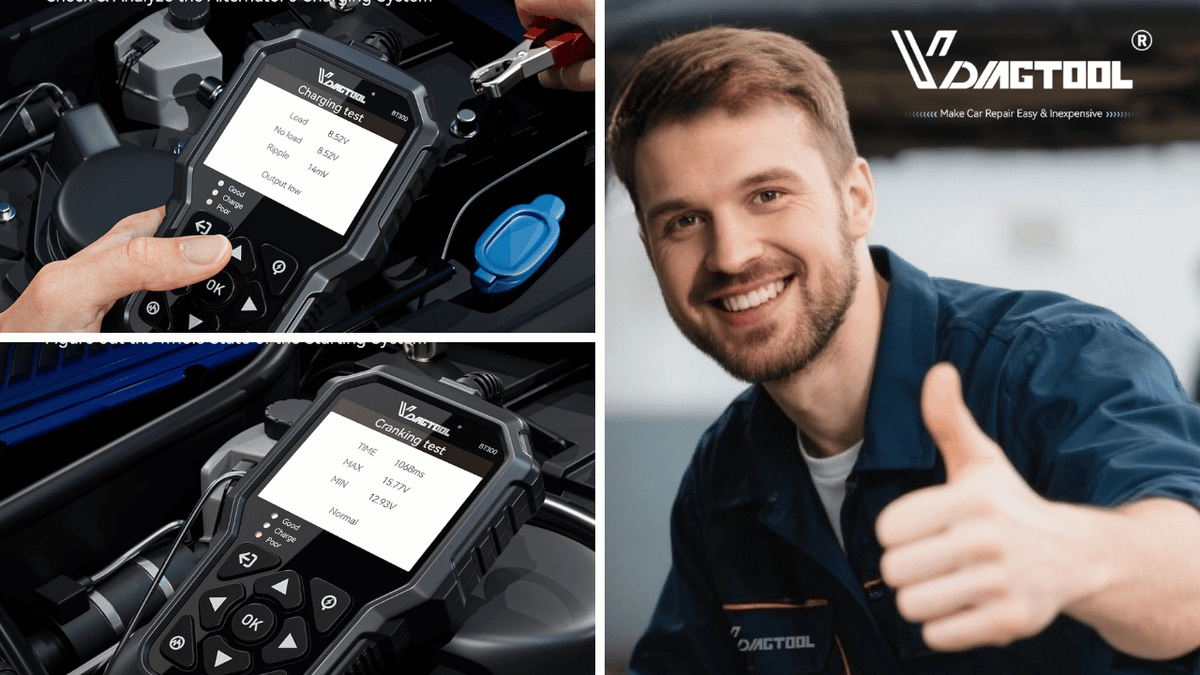
 Todd Bandel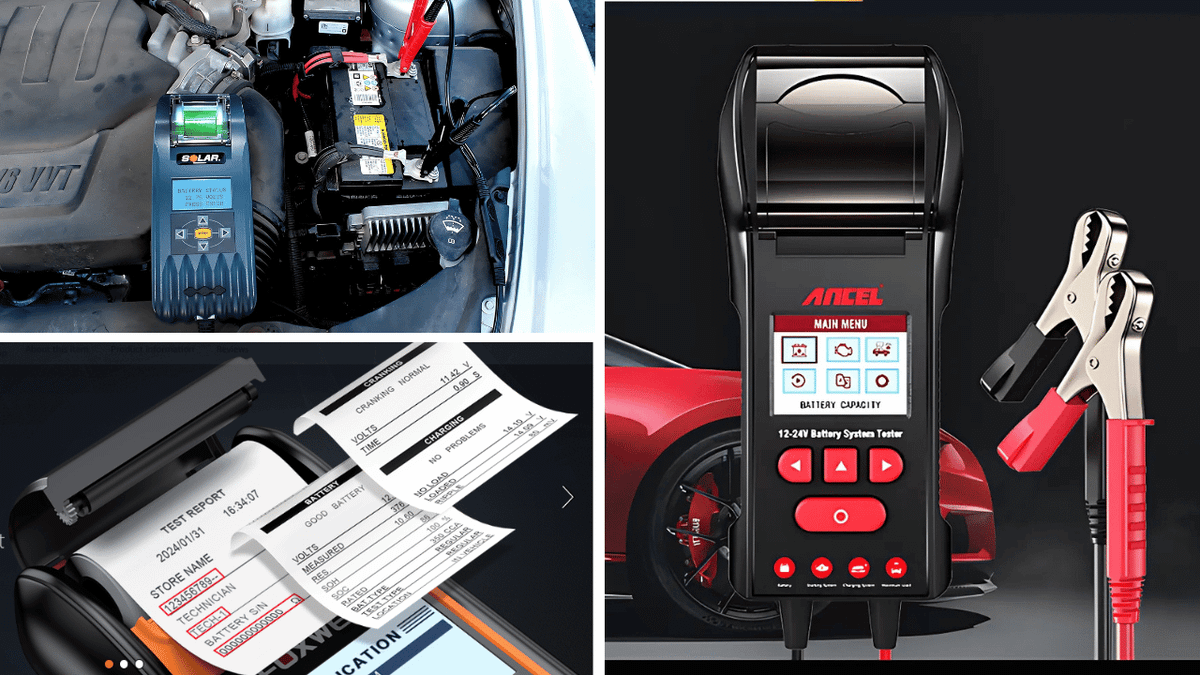
 Todd Bandel
 Todd Bandel