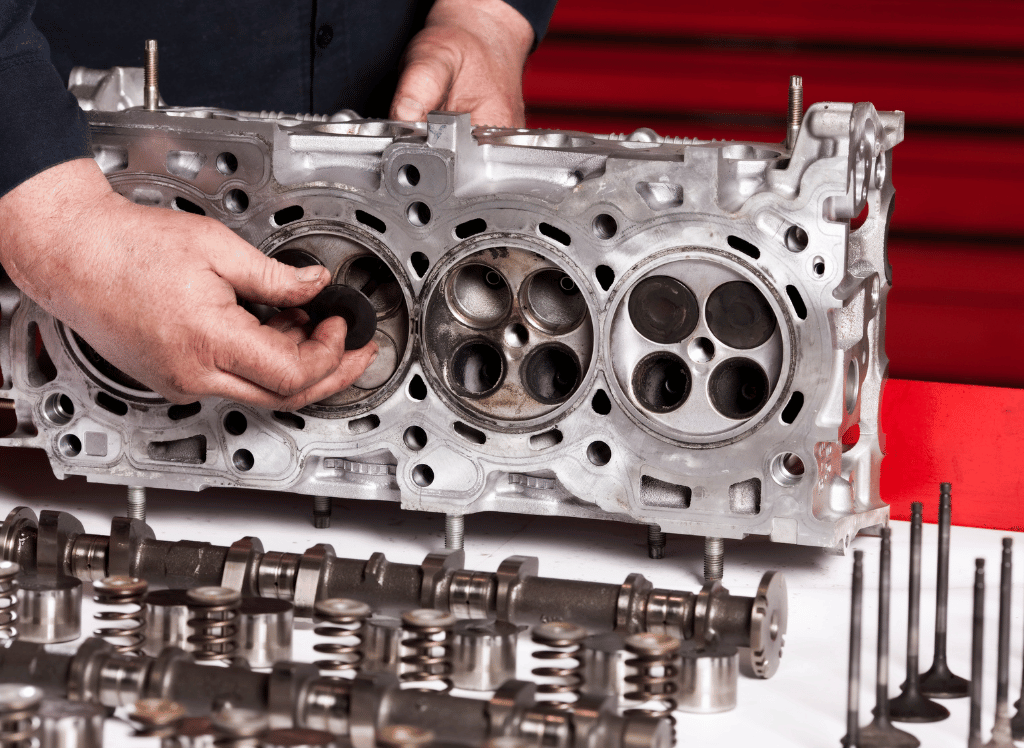
Porting and Polishing Kit Guide for Cylinder Heads
Boost engine power with a pro porting and polishing kit for smoother airflow, more horsepower, and DIY cylinder head gains for serious builders.
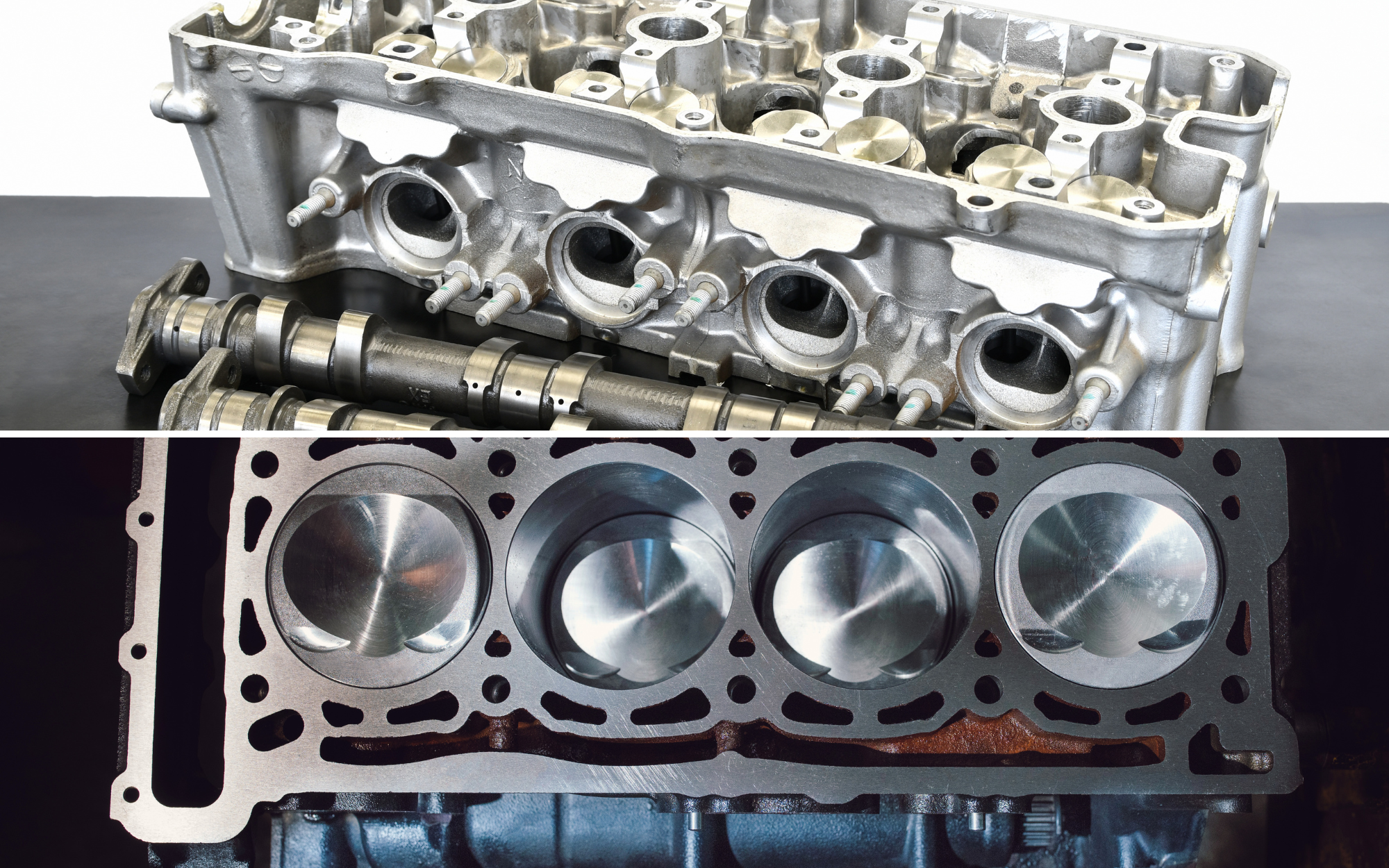
A porting and polishing kit gives you a practical way to extract more airflow and power from cylinder heads without sending them to a machine shop. Whether you're prepping a set of small-block Chevy castings for the drag strip or cleaning up the ports on an import 4-cylinder daily driver, the right kit puts the abrasives, mandrels, and finishing tools you need in one box. This guide covers what's in a typical kit, how each component works, and how to use it without ruining your cylinder heads.
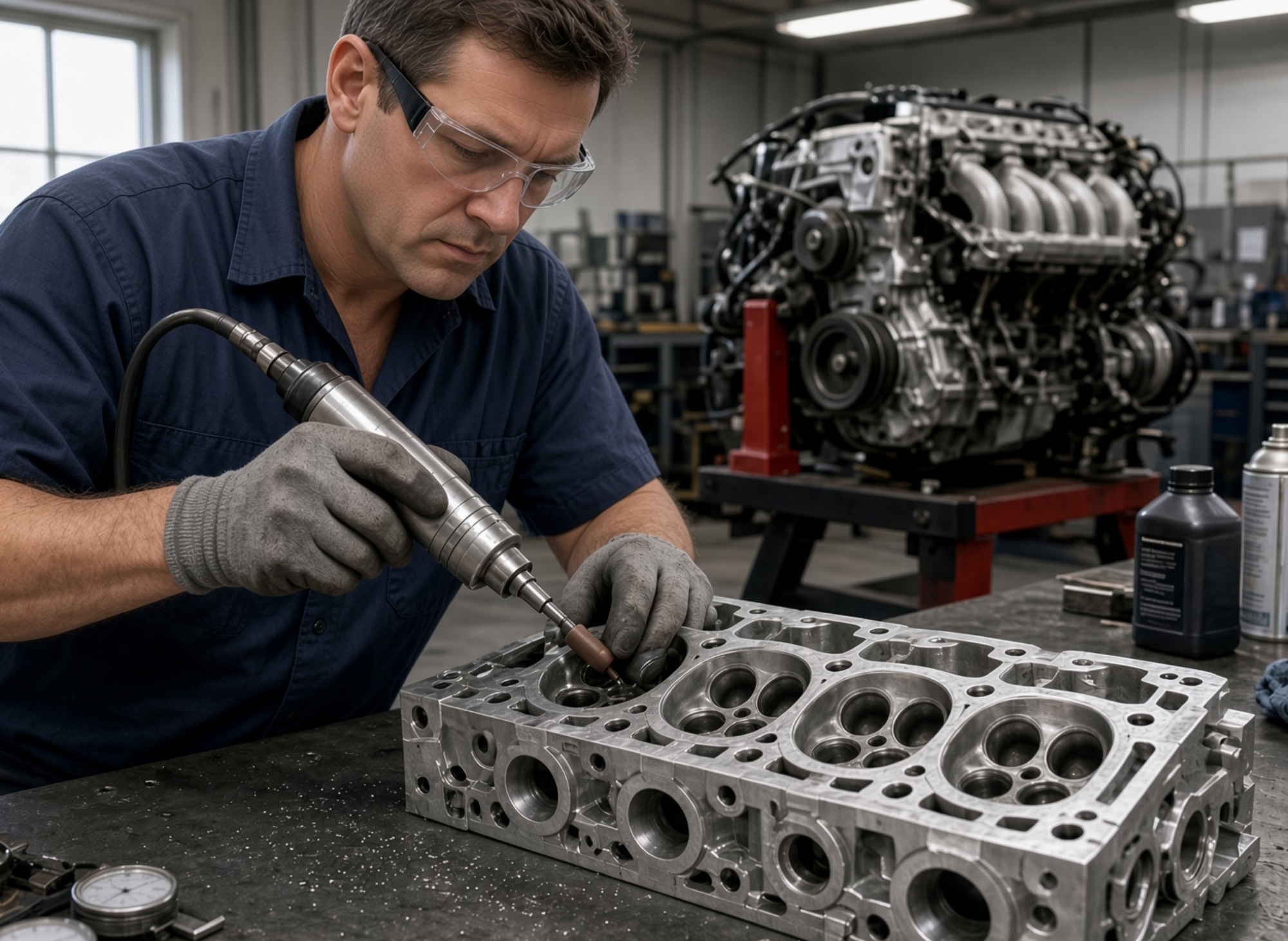
What a Porting and Polishing Kit Is (and When You Need One)
A porting and polishing kit modifies engine cylinder head passages using a collection of abrasive rolls, grinding stones, mandrels, and finishing wheels. These tools mount in a standard electric drill or a 1/4-inch-shank die grinder, and they let you reshape, blend, and smooth the intake runners, exhaust ports, and combustion chambers of cast-iron or aluminum heads.
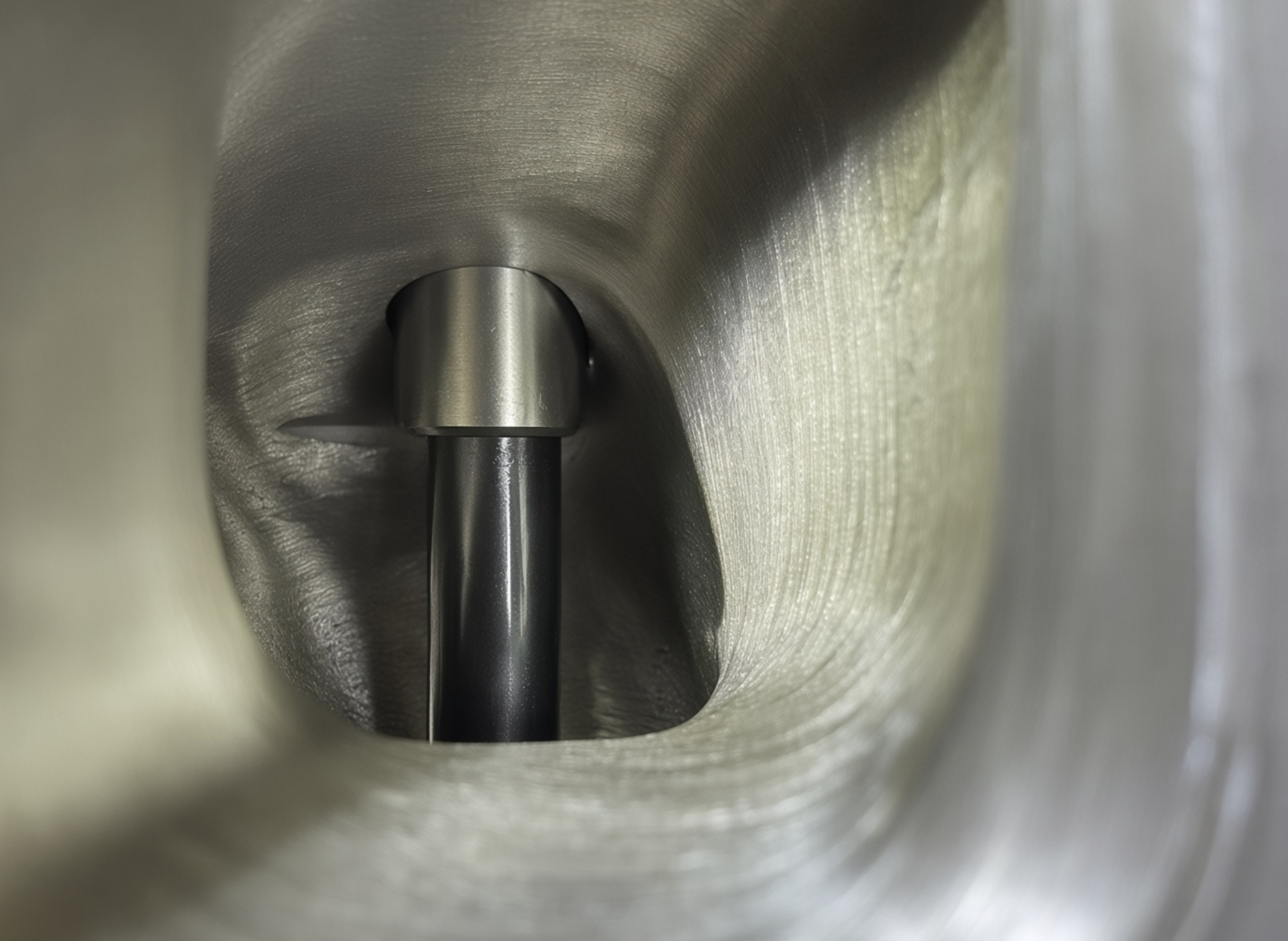
- A porting and polishing kit exists to solve one problem: stock cylinder head castings leave the factory with rough surfaces, misaligned port openings, and casting flash that restricts airflow into the cylinders. Removing rough edges increases airflow volume into combustion chambers, which translates directly to better breathing at every RPM.
- Polishing and porting are related but distinct operations. Porting means reshaping and enlarging runners, bowls, and the short-side radius to improve the path air takes into the cylinder. Polishing means smoothing those reshaped surfaces with progressively finer abrasives for a controlled finish. A good polishing kit covers both stages.
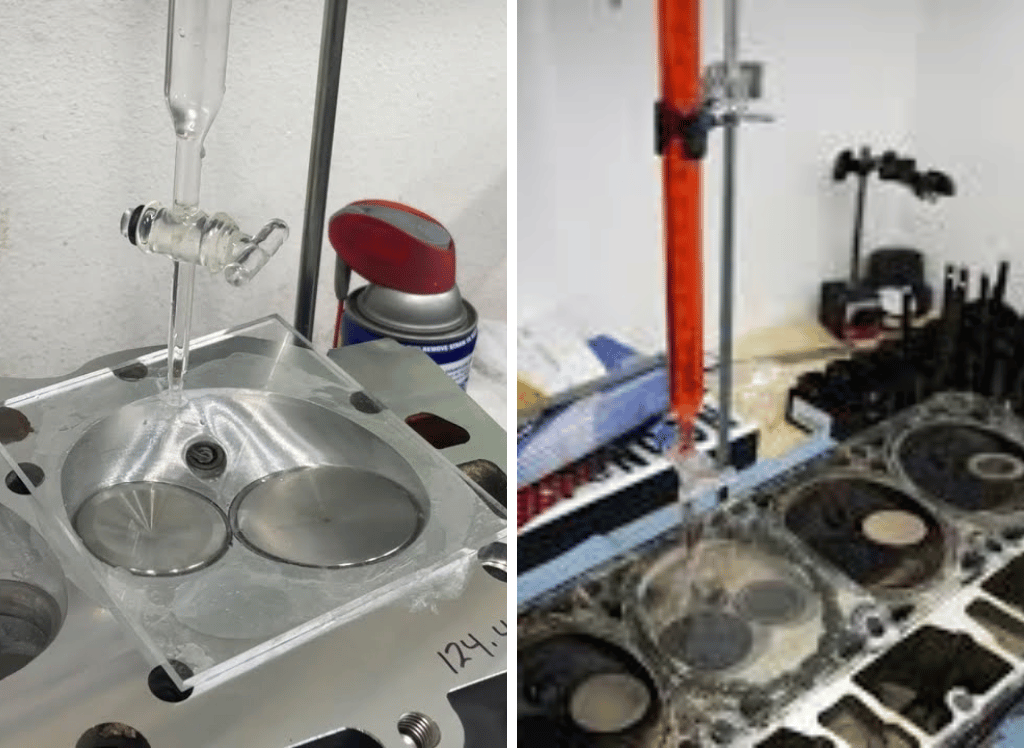
- Porting reduces airflow restrictions caused by casting imperfections. Reduced turbulence improves volumetric efficiency in the combustion cycle, and a well-executed port job improves throttle response and high-RPM breathing. Enhanced airflow increases the horsepower and torque output of the engine. In one documented small-block Chevy build, intake port flow jumped from 184 cfm to 303 cfm after porting Dart 200-cc heads, producing a gain from roughly 404 hp to 482 hp.
- Porting kits can polish aluminum and cast iron heads, though the abrasive type and technique differ between the two materials. Aluminum is softer and more heat-sensitive; cast iron is harder and needs more durable abrasives. Kits like the JEGS 92-piece port and polish set (90 cartridge rolls plus 2 mandrels) and the Mr. Gasket 4362 (28 rolls, 3 mandrels, flap wheel, and tapered grinding stone) are built to handle both.
- These kits are popular with street and strip enthusiasts working on small-block Chevy, LS, Ford Windsor, or import 4-cylinder heads. A basic street/strip port job at a machine shop typically runs $400 to $600 in labor. A DIY kit costs under $200, sometimes under $100, and puts the work in your hands.
- Polishing/Porting kits include tools for 2-stroke and 4-stroke engines. While most automotive work targets 4-stroke heads, 2-stroke porting kits fit 125cc to 500cc engines and use many of the same abrasive types on smaller port dimensions. The sign that you need a kit is straightforward: if you're leaving free airflow on the table because of factory casting quality, a porting and polishing kit is the most cost-effective next step.
What's Inside a Typical Porting and Polishing Kit (Including Cartridge Rolls and 1/4 inch shank tool)
Most cylinder head polishing kit bundles follow a similar formula: cartridge rolls in multiple grits and shapes, steel mandrels sized for 1/4-inch shank tools, flap wheels or buffs for finishing, and sometimes a grinding stone or two for initial rough work.
The piece count varies from basic 28-piece starter sets to pro-level assortments with 55 to 92 pieces. A good porting kit includes various shapes of carbide burrs and abrasives, though some kits focus on cartridge rolls and finishing tools while expecting you to source carbide burrs separately.
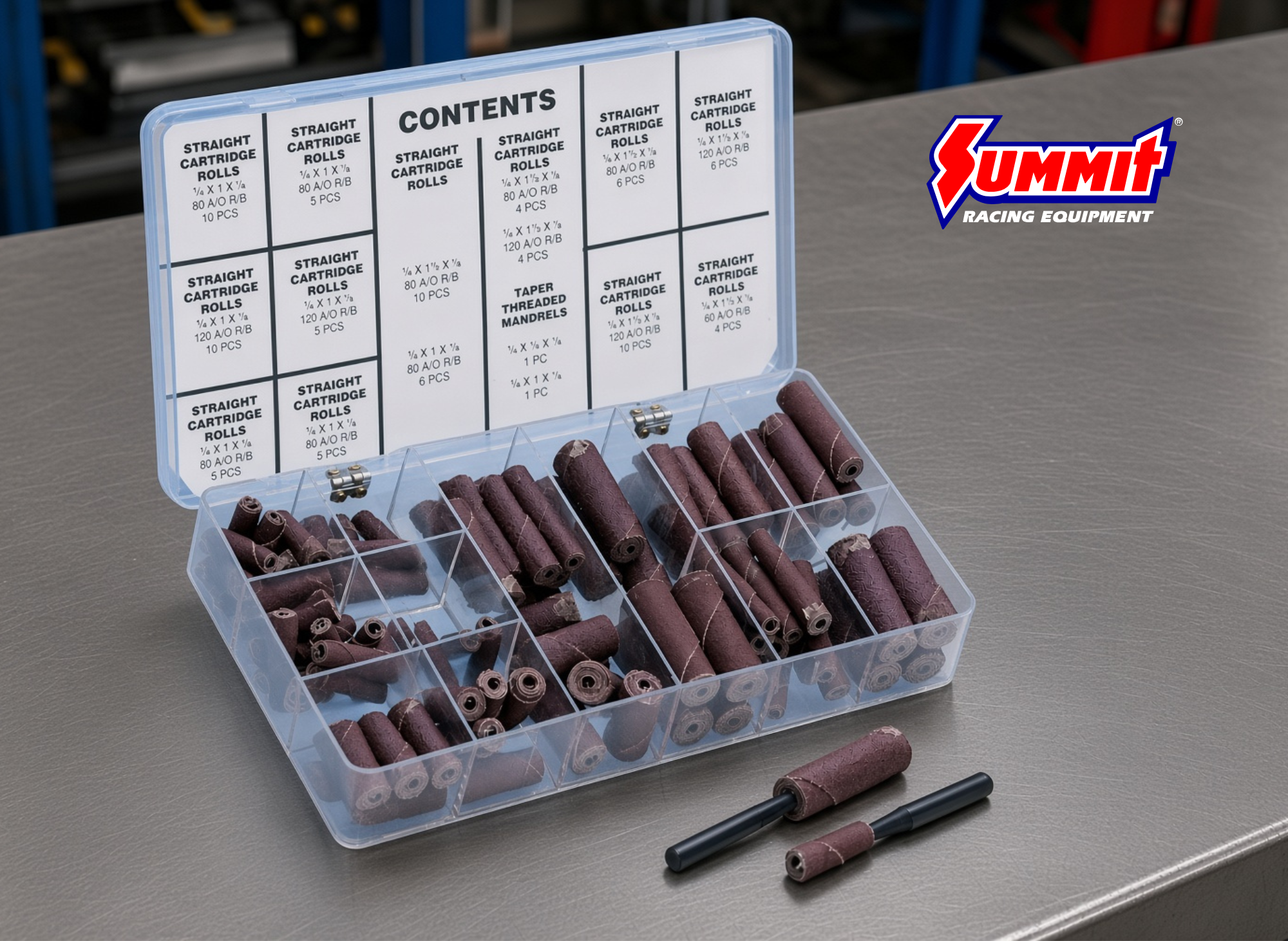
Summit Racing™ Porting and Polishing Kits SUM-G1060
Port and Polishing Kit, 92-Piece, Cartridge Rolls, 60/80/120-Grit, Assorted Sizes, 1/4 in. Shank Mandrels, Aluminum Oxide, Kit
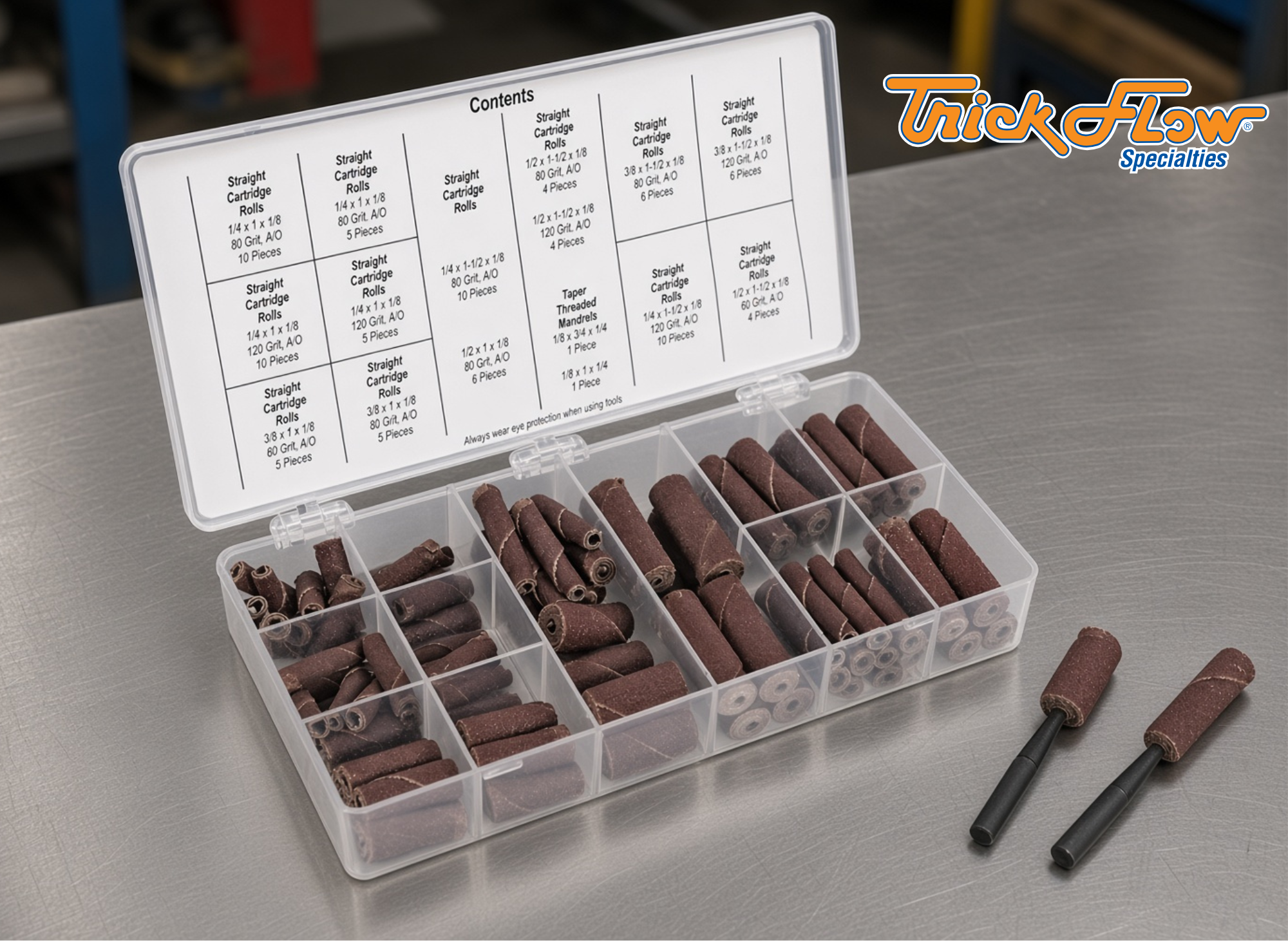
Trick Flow® Deluxe Cartridge Roll Porting Kits TFS-90001
Port and Polishing Kit, 86-Piece, Cartridge Rolls, 60/80/120-Grit, Assorted Sizes, 1/4 in. Shank Mandrels, Kit
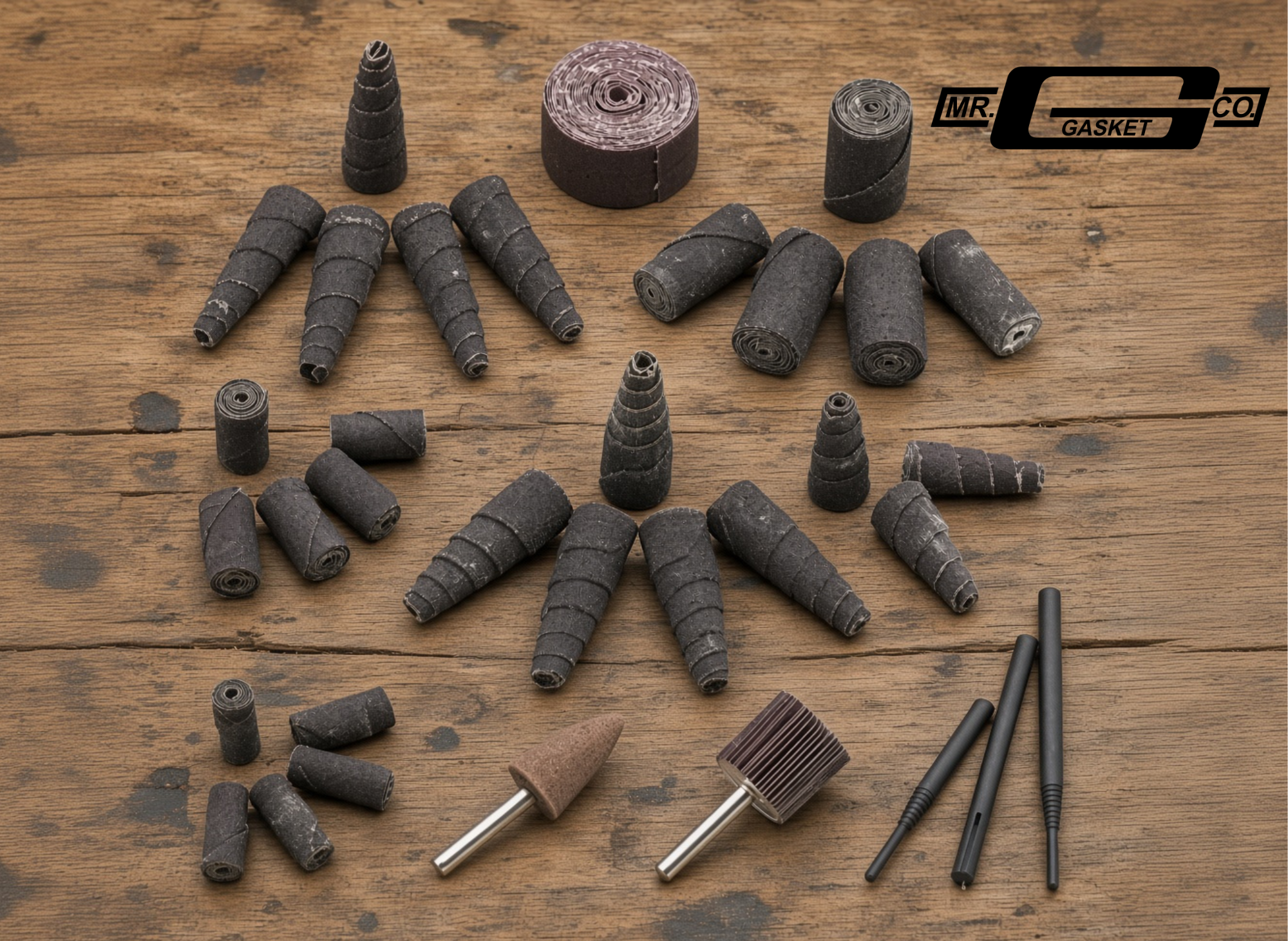
Mr. Gasket Engine Port Polishing Kits 4362
Porting and Polishing Kit, Deluxe Porting, 36 Pieces, Clear Plastic Case, Kit
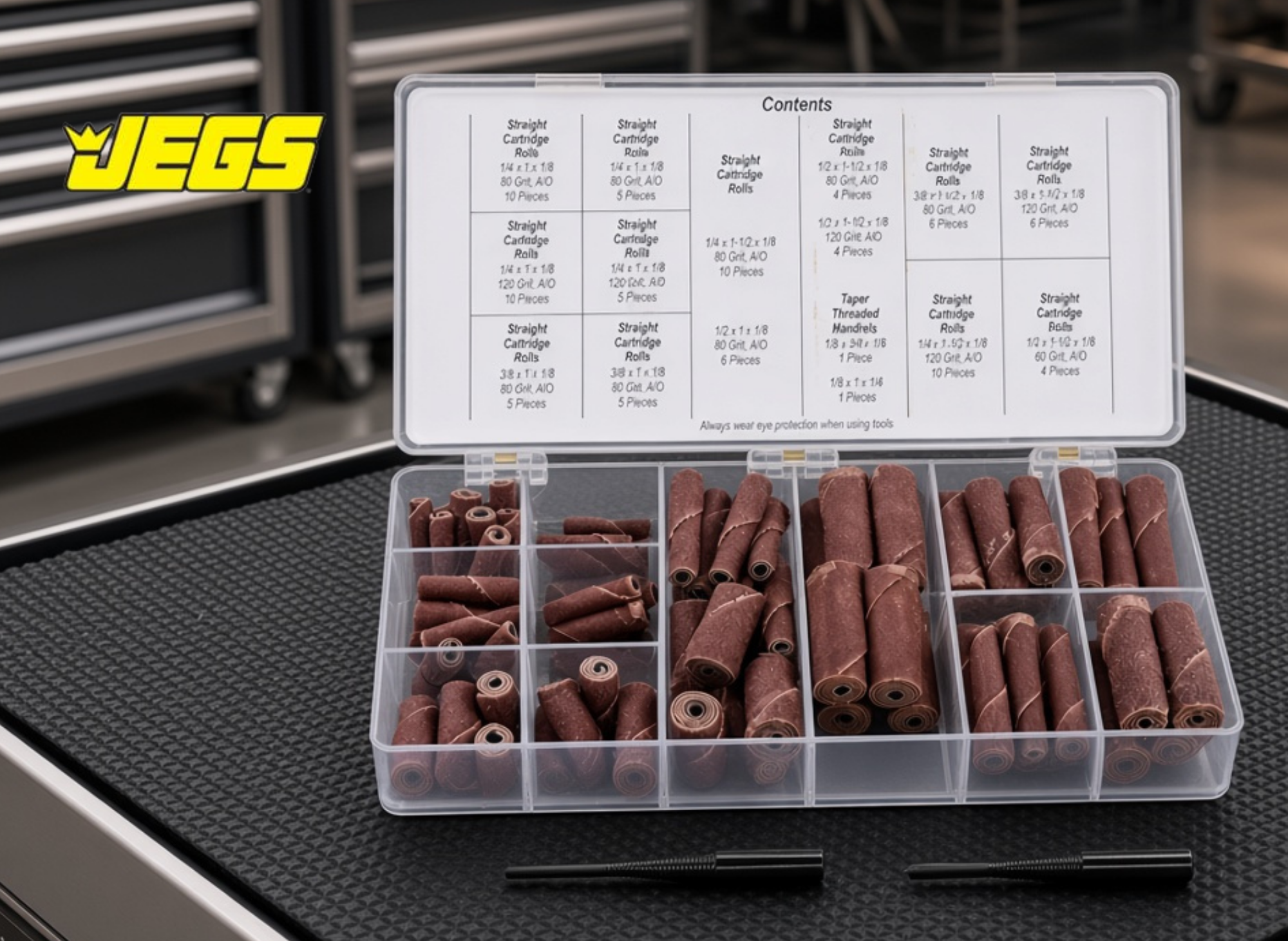
JEGS 92-Piece Port & Polish Kit
90 CARTRIDGE ROLLS, 2 MANDRELS included for virtually any application
- Cartridge rolls are the core of any polishing kit. These small, resin-bonded abrasive cylinders come in straight and tapered profiles. Cartridge rolls come in various grits for polishing: 60-grit for aggressive material blending, 80-grit for refining port shape, and 120-grit for final smoothing. Common diameters include 1/4-inch, 3/8-inch, and 5/8-inch, with lengths around 1 to 1.5 inches. Straight rolls handle open port walls; tapered rolls reach into tight spots near the valve guide boss and short-side turns.
- Mandrels are steel arbors that hold each cartridge roll and mount into your tool's chuck or collet. Kits typically include at least two lengths. Shorter mandrels (around 2.75 to 4 inches of pilot length) work well in shallow or wide ports. Longer mandrels (5 to 6 inches) are needed for deep, narrow V8 intake and exhaust passages. Some are slotted, others tapered, to accept different roll types. The Mr. Gasket 4362, for example, ships with slotted and tapered mandrel styles.
- Flap wheels and buffs handle the final finish. Flap wheels contour to curves and smooth metal surfaces, which makes them ideal for combustion chamber edges and valve bowl blends. Buffs (sometimes called X-buffs) add even finer polishing capability. The Cylinder Head Supply Deluxe kit includes two 1-inch 120-grit flap wheels, two medium heavy-duty X-buffs, and two extra-fine heavy-duty X-buffs. Polishing compounds can be applied to buffs to achieve a near-mirror finish on exhaust ports and chambers.
- Grinding stones appear in many kits for first-pass work: knocking down casting flash, defining gasket-match scribe lines, and shaping rough sections before switching to cartridge rolls. They're typically tapered for access into port transitions.
- Carbide burrs and specialty abrasives: Sanding rolls and cartridge rolls refine surface texture after using carbide burrs, which do the heavy lifting of major metal removal. Long shank carbide burrs are available for aluminum and cast iron in various profiles (tree, flame, cylinder, ball). Some kits bundle these in; others, like the JEGS set, focus on rolls and mandrels. The D44SRMC Kit, for instance, is designed specifically for 4-stroke cylinder heads, while the Basic Starter Kit includes a 44MC rotary hand tool for entry-level users. A deluxe porting kit includes 55 pieces for various tasks; the Superior Abrasives kit also includes 55 pieces for porting, covering a range of roll sizes and grits.
- Abrasive material types vary by kit. Aluminum oxide is the standard for general work on aluminum heads. Zirconia alumina and ceramic abrasives last longer on hard cast iron or hardened valve seat inserts. Some specialty kits mix in silicon carbide bullets or diamond points for the hardest surfaces.
- Flex hones are a related tool used for finishing cylinder walls rather than ports, but they sometimes appear in broader engine prep kits. They're useful if you're freshening the bores while the heads are off.
- Compatibility: quality kits are built for 1/4-inch collet die grinders or 3/8-inch electric drills. Safe operating speed matters. Eastwood's kit instructions specify a maximum of 22,000 rpm for die grinder use. Mr. Gasket caps their rolls at 18,000 rpm. Exceeding these limits causes premature wear and creates unsafe conditions. Before you order a kit, check that your tool can run at controllable speeds within these ranges.
How to Use a Porting and Polishing Kit on a Cylinder Head
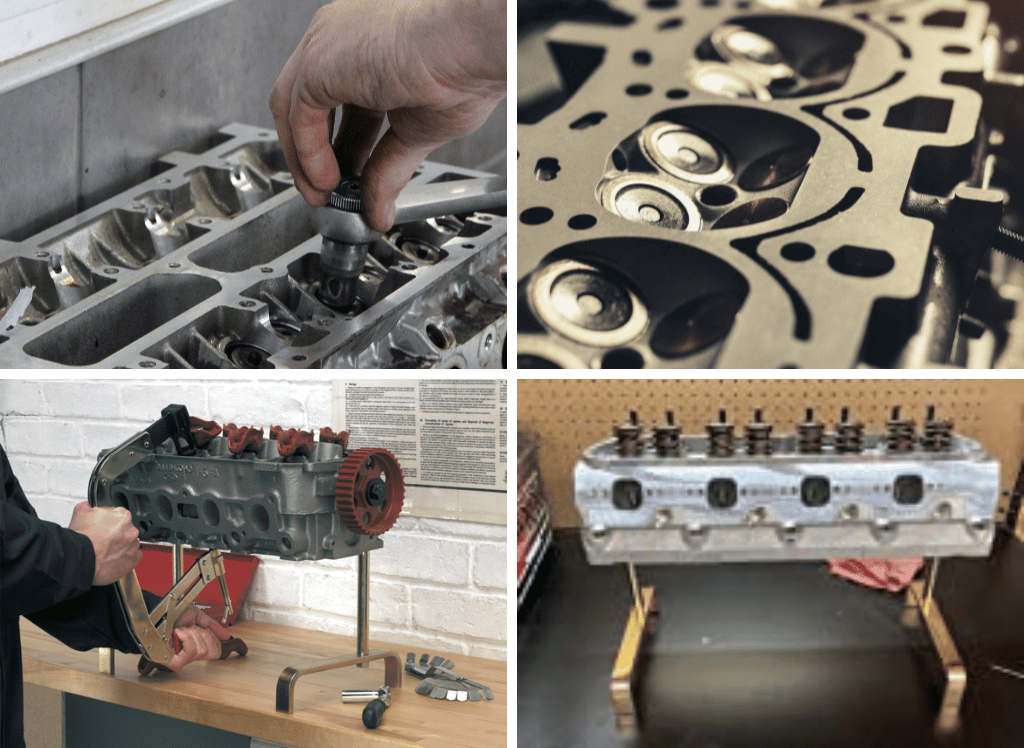
Before you touch an abrasive to metal, gear up. Personal protective equipment is necessary when porting to avoid inhalation of fine aluminum or iron dust. Wear safety glasses, a respirator rated for metal particulate, gloves, and long sleeves. Secure the cylinder head in a bench vise or dedicated fixture so it cannot shift while you're grinding. Remove all jewelry.
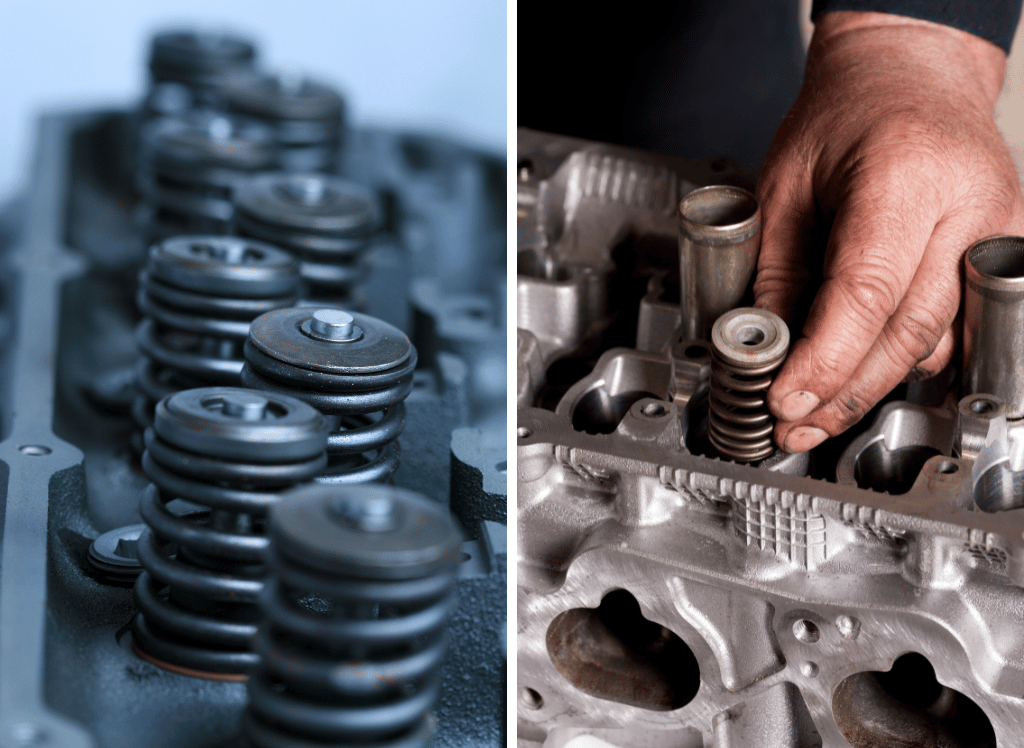
- Prep the head. Fully degrease the casting with solvent or a parts washer. Remove valves, retainers, seals, and springs. Clean carbon deposits from combustion chambers and exhaust ports. Lay your intake manifold gasket over the port face, secure it with small bolts or tape, and trace the port outlines onto the casting with machinist's dye or a fine-tip marker. These scribe lines are your limit for material removal during gasket matching. Repeat on the exhaust side with the header or exhaust manifold gasket.
- Rough shaping comes first. A die grinder is used for metal removal in porting, typically fitted with carbide burrs. Cartridge rolls are not meant for aggressive reshaping; they're finishing tools. Use a tree-shaped or flame-shaped carbide burr to remove casting flash, widen the port opening to the scribe line, and blend the short-side radius. Work in passes, not plunges. The goal is to reshape port geometry so it optimizes air velocity and ensures rapid cylinder filling, not to remove as much metal as possible.
- Blending with coarse rolls. Once major obstructions are gone, switch to 60-grit cartridge rolls on your mandrel. Blend the transitions between freshly burred areas and the untouched port walls. Focus on the short-side turn (the tight radius on the floor of the port near the valve bowl) because this is where airflow separates from the wall and turbulence forms. A smooth, gradual radius here is worth more than a larger port opening.
- Refining with medium rolls. Move to 80-grit rolls and work the entire port surface. This step removes the scratch pattern left by the 60-grit and begins to create a uniform texture. On intakes, 80-grit is often the stopping point for the runner walls. A slightly textured surface helps fuel atomization in port-injected engines; too smooth a surface causes fuel to bead and drop out of suspension.
- Finishing with fine rolls and flap wheels. Use 120-grit cartridge rolls for a final pass on intake bowls and valve approach areas. On exhaust ports and combustion chambers, continue with flap wheels and buffs to achieve a finer finish. Smoother exhaust surfaces reduce carbon adhesion and lower heat retention. Combustion chamber polishing also helps control detonation by eliminating sharp edges that can become hot spots.
- Mandrel selection matters. A 1/4-inch shank, long-reach mandrel combined with tapered cartridge rolls is the only practical way to reach deep into the narrow intake runners on small-block Chevy and Ford Windsor heads manufactured from the 1960s through the 2000s. Shorter mandrels work for import 4-cylinder heads with stubby, direct ports. Use larger-diameter rolls on intake walls (more surface area to cover) and smaller rolls in exhaust ports or tight valve guide boss areas.
- Watch wall thickness. Not all castings have the same amount of metal between the port wall and the water jacket. Older castings and budget aftermarket heads can be thin in places. Check wall thickness by tapping the surface and listening for a change in pitch, or use a sonic thickness gauge if one is available. Porting too much material can decrease air velocity and hurt performance; it can also breach into a coolant passage, which turns a weekend project into a scrap head. Over-porting reduces flow velocity at low RPM, costing torque and drivability for gains that only appear at wide-open throttle on a high-lift camshaft.
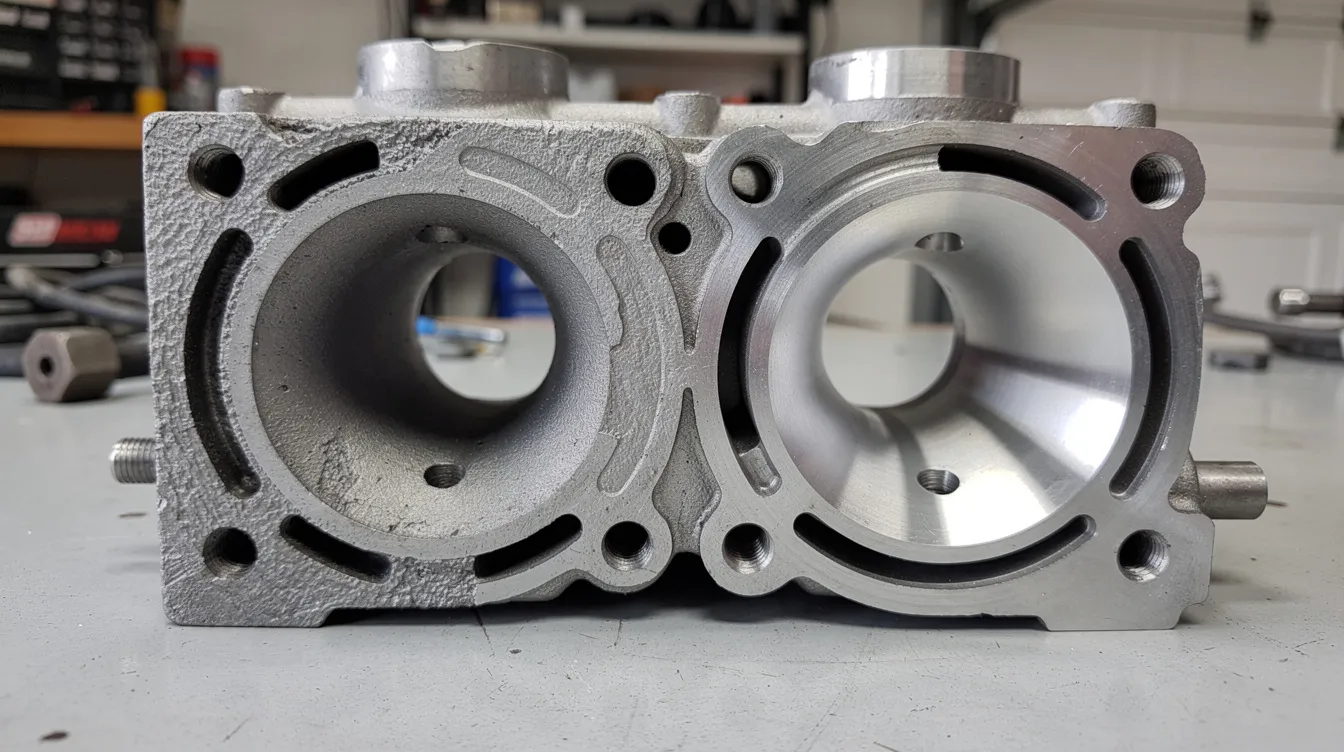
Step-by-step summary:
Disassemble the head and inspect for cracks or warpage. Clean all deposits. Scribe gasket outlines with dye. Remove casting flash and major obstructions with carbide burrs in a die grinder. Blend with 60-grit cartridge rolls.
Refine with 80-grit rolls. Finish with 120-grit rolls, flap wheels, and buffs. Protect valve seats and guides throughout by inserting old valves or masking the seats. Wash the head thoroughly after all abrasive work to remove every particle of grit and metal debris.
Reassemble with new seals and springs. The entire process on a pair of V8 heads takes anywhere from 4 to 12 hours, depending on your experience and how aggressively you reshape the ports. A kit under $200 and a weekend of focused work can produce results that rival a $400 to $600 machine shop bill, provided you take your time, check your progress, and resist the urge to chase a number on the flow bench that your cam and intake combination can never use.
Frequently Asked Questions
Do I need a die grinder, or will a regular drill work?
A high-speed die grinder (air or electric) with controllable RPM is strongly preferred. Regular drills lack the speed and control needed for efficient work and can load abrasives more quickly.
How much horsepower can I expect?
Realistically, 8–15+ hp on a typical street engine when combined with a good valve job. Results vary widely with the starting heads and the rest of the combination.
Should intake ports be mirror-polished?
No. An 80-grit finish is usually preferred on intake runners to help keep fuel suspended. Exhaust ports and chambers can be finished more smoothly.
Can these kits damage heads?
Yes—if you remove too much material, break into a water jacket, or damage the valve seats. Work carefully and check the thickness.
Are the kits suitable for both aluminum and cast iron?
Yes, most are. Adjust technique, use appropriate abrasives, and expect different wear rates on the rolls.
Final Thoughts on the Porting and Polishing Kit
After decades of tearing down, building, and modifying engines,everything from small-block Chevys and LS swaps to performance heads on muscle-car projects,a good porting and polishing kit has earned a permanent spot on the bench.
These kits (the popular 60–90+ piece assortments with cartridge rolls, spiral cones, mandrels, and sometimes mounted points or flap wheels) are not magic. They will not turn a stock head into a full CNC race piece. But used correctly, they deliver real, measurable gains in airflow, throttle response, and consistency that you can feel on the street or track.
What We Actually Use Them For on Engine Builds
In our shop and on personal projects,s we rely on these kits for the practical work that makes the difference between a clean rebuild and a properly breathing engine:
Gasket matching / port matching: Aligning the intake and exhaust ports to the gasket and manifold openings. This is one of the highest-return jobs you can do. Removing the step or mismatch that traps air is simple with the right cartridge rolls and pays off immediately in flow.
Removing casting flash and smoothing runners, Factory heads (especially iron and older aluminum castings) have ridges, parting lines, and rough spots. We clean those up without opening the ports excessively. An 80-grit finish on the intake side is usually ideal, smooth enough for good flow but still providing the slight turbulence that helps keep fuel in suspension. Exhaust ports get smoothed a bit more aggressively.
Bowl blending and short-side radius work: careful work around the valve bowls and short-side radii with the tapered and spiral rolls. This is where a lot of the power lives. We stay away from the valve seats themselves and never chase a mirror finish on the intake runners.
Cleanup on intakes, lifter valleys, and exhaust manifolds. Beyond the heads, the same kit cleans casting marks on intake manifolds, deburrs block decks and valleys, and tidies up header flanges or exhaust ports.
On LS-swapped Camaros, classic small-block builds, and the occasional aluminum performance head, these kits have been the go-to for the DIY-level porting that sits between stock and professional CNC work. When time and budget allow a full professional port job, we still use the kit for final touch-up and matching. The combination of different grit cartridge rolls (typically 60/80/120) and the two mandrel lengths covers almost every reach needed inside a typical V8 head without constant tool changes.
Realistic Expectations
A basic home port-and-polish with one of these kits commonly yields 8–15+ horsepower on a street engine when combined with a proper valve job, depending on the starting head and the rest of the combination. The biggest improvements come from consistency and elimination of restrictions rather than dramatic size increases. Over-porting or chasing a mirror finish on the intake side can actually hurt mid-range torque and fuel atomization, something we learned the hard way years ago.
The kits themselves are consumable tools. The rolls load up (especially on aluminum), so keep some grinder’s grease handy and replace rolls as they wear. Pair the kit with a decent high-speed die grinder (electric or air, controlled RPM preferred) and proper safety gear; eye protection, gloves, and a respirator are non-negotiable. Metal dust is not something you want in your lungs.
Bottom Line for MechanicAddicts Readers
If you are already comfortable working on engines and want to extract more performance without sending the heads out, a quality porting and polishing kit is one of the better investments you can make.
It pays for itself the first time you gasket-match a set of heads or clean up a rough set of castings. We keep one on the shelf and reach for it regularly on personal builds and customer work alike. It will not replace a skilled cylinder-head porter with a flow bench, but it will let a competent mechanic deliver cleaner, better-flowing ports that make the rest of the engine combination work harder.
For most street and mild performance builds, this is the practical tool that bridges the gap between stock and serious. Use it thoughtfully, respect the limits of what hand tools can safely achieve, and it will reward you with better-running engines.
Thank you for reading!
Your friend,
Todd
This site contains affiliate links, and we may earn a commission at no extra cost to you. All recommended products are thoroughly vetted.
Amazon Prime offers a wide range of products to meet diverse customer needs, with the added benefit of fast, reliable delivery. From household essentials and groceries to electronics, clothing, and entertainment, Prime members get access to exclusive deals and discounts across a wide range of categories.
Additionally, Prime membership includes access to services like Prime Video for streaming movies and TV shows, Amazon Music for ad-free music, and Prime Reading for eBooks and magazines. This comprehensive suite of benefits makes Amazon Prime a convenient and value-packed option for millions of customers worldwide.
- Prime for young, adult
- Free 30-day trial of Prime
- All of Prime, half the price.
- Prime Video
- Wedding Registry
- Kindle Unlimited
 Todd Bandel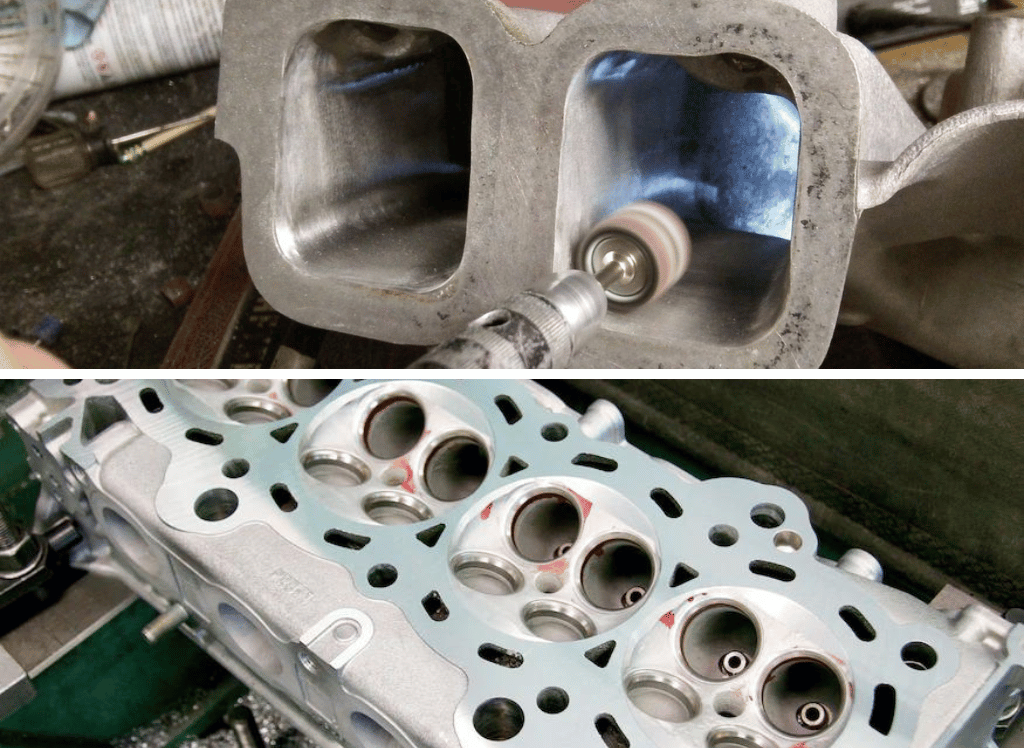
 Todd Bandel
 Todd Bandel
 Todd Bandel
 Todd Bandel
 Todd Bandel
 Todd Bandel